Showing posts with label Cuerici. Show all posts

Friday, February 25, 2011

Cuerici, pt. 3: Valentine's Day, Tico Style

After we got back from the paramo, we had an evening "fireside chat" with Don Carlos about his life experiences. We got to hear some amazing insight about how he founded the Cuerici reserve, and about how he feels about conservation, both in Costa Rica and in general. Since Valentine's Day was the next day, we spent the rest of the night writing nice messages to each other on Valentine's cards that Anna, Lee, and Ellen had made for everyone in the group, including our professors and Don Carlos! It was a really sweet idea, and the next morning when we were eating breakfast we got to read our cards, which had messages from all 27 of our classmates. We had the morning free, which most people spent working on their statistics homework, and all afternoon we had an additional statistics workshop. Before dinner I went out and did my field notebook assignment (30 minutes of observations, required at every site we go to) on the back end of the oak forest trail. 

After dinner we had a discussion about the pros and cons of private vs. publicly-funded conservation, and then a group of us decided to hike back up to the mountain to look at the stars from the lookout point we'd seen during our hike with Don Carlos. About half of us decided to sleep out in an old lean-to a few minutes down the trail from the lookout, so we packed up our sleeping bags, some blankets, and snacks and headed out. 
The shack that we slept in, as seen during the day when we first found it.
It took us about an hour to hike up in the dark, with only our head lamps for light. Those of us who were sleeping out were layered up thickly since, at that elevation, it gets REALLY cold at night. I had a blanket, extra socks, water, and some random supplies in my backpack and my sleeping bag strapped to the bottom, leaving no room to pack any of my extra layers. I just decided to wear them on the way up that way I'd have them when it got cold that night. Unfortunately that was not the best decision, and everyone who was dressed to sleep out got really sweaty on the way up the steep trail, and we had to take layers off before we went to sleep because they were damp. I did the hike wearing three pairs of pants, a tank top, two t-shirts, a long-sleeve shirt, a fleece, a button-up field shirt, and a flannel.

The night hike crew getting ready to leave. I am literally wearing the maximum number of layers that I could put on my body.
We may have been sweaty when we got to the top, but we were happy! The view was amazing at night. We hung out on the lookout platform singing songs and talking for a few hours. After the people who weren't sleeping out began to hike back down, we sat in silence just watching the fog lap up against the mountains like an ocean breaking on the shore. As the clouds moved through the valley the little town would come in and out of our view, sometimes disappearing entirely under the mist so that the only light we could see was from the moon. It was incredible! After about an hour of just soaking in the mountains at night and reminding ourselves how lucky we were to be where we were, we started to get ready for bed. We walked over to the hut and arranged ourselves on the floor, avoiding the places where tree branches were coming in between the floorboards.
Up on the mountain, ready for bed! I didn't bring a winter hat to Costa Rica, so I was wearing a scarf to sleep. Haha.
We attempted to strike a balance between having a comfortable amount of personal space and sharing body heat so we'd be warm enough to fall asleep, which proved to be challenging. Around 2 or 3 am I could hear someone else still moving around, clearly awake like I was, so I sat up and saw Tessa also sitting up in her sleeping bag. We were sleeping in opposite directions and both immediately decided to rearrange so that we could sleep closer together. We did the best we could to "cuddle" while both fully zipped up in mummy-style sleeping bags, which meant I more or less slept halfway on top of her. After we moved we were both finally able to fall asleep! 

We all woke up around 5:20 the next morning because it was beginning to get light out. We walked back over to the lookout point to watch the sun rise over the mountains, which was amazing. My camera could not even come close to capturing it, by I took some photos anyway.


After admiring the sunrise for a bit, we decided to do some yoga on the lookout point. Hilary led us in some sun salutations, which served the dual purpose of being awesome and helping us stretch out after a cramped and chilly night on the mountain.

When we finished our yoga, we packed up our stuff and hiked back down the mountain to the field station, just in time for breakfast! It was really a delicious breakfast, too, after so much activity and so little sleep the night before. We got changed quickly and then left at 7:30 with the rest of the group for a day trip to El Sitio, another more remote field station that Don Carlos manages. It was our last full day in Cuerici, and instead of having regular classes or an informational hike, we had a relatively non-academic trip planned just to enjoy ourselves and our surroundings.
El Sitio station
From the road, it took just over an hour to hike to the station. We only stopped for a minute for a few people to use the bathroom, and then kept hiking. We were on a quest to see some amazing sights, including a large waterfall and a really old tree. While we didn't know in advance where we were going, the tree turned out to be our first destination. 

Arriving at the huge oak tree
There are buttresses at the bottom, even at the narrower parts above them the tree is still about 6 m in circumference. At the very base, it took 7 students' arm spans to reach around the tree. It's hard to tell tree ages in the tropics because the year-round growing season doesn't result in the formation of the rings that are so common in the temperate zone. Also, due to physiological limitations, most trees are incapable of growing much taller than a maximum height, so that also couldn't give reliable clues to the tree's age. However, because of its enormous girth and its size relative to other trees growing nearby, Don Carlos and our professors estimate that it is between 1,000 and 2,000 years old. I spent a good deal of time just thinking about how much the forest around this tree must have changed throughout its lifetime, and all of the world events that it's lived through. It's just mind-boggling!

The 1,000+ year-old oak tree, with me for scale
I'm kind of a sucker for trees, so I was pretty excited that we got to see one so incredible. After giving us a sufficient amount of time to be amazed, our professors led us to the waterfall, which was our second destination on the hike. It was a pretty cool waterfall, and was really beautiful. It looks like what you expect the tropics to look like, in a good way. In my opinion, it wasn't quite as breath-taking as the oak tree, but it was definitely worth hiking to.

Hanging out at the waterfall. Unintentionally in the foreground: Ashur.

The view from about half way up


After frolicking in the waterfall for a bit, we hiked back to El Sitio station and ate the lunches that we'd packed with us after breakfast. It started to rain and I was feeling kind of chilly (probably in large part due to the little sleep I got the night before), so I was glad when we started the hike back to the road because I could generate some body heat. When we got back to Cuerici I took an AMAZING hot shower (the water there was even better than the water at Las Cruces!) and really felt warmed up for the first time in many hours. We had one class in the afternoon, which was a science writing workshop, getting us ready for the projects we'd be doing at our next station. 

For our last night in Cuerici, we had a special dinner courtesy of Don Carlos and his trout farm. The afternoon before he let us help him catch fish from his canals, and then kill and gut them ourselves. I didn't kill or clean any of the fish, but almost everyone else did. In total I think we harvested 16 trout for our dinner Tuesday night. The kitchen staff there cooked them for us, and the trout ended up being one of the best meals I've had in Costa Rica. You could definitely taste how fresh the fish were, and how much care Don Carlos takes while raising them. After a day (and night, for many of us) full of hiking, bellies full of fresh trout made for a happy bunch of students. 

Unfortunately we had to spend the rest of the night packing, since we were leaving the next morning! By "rest of the night" I mean "from about 7:30 to 8:30 pm," since as soon as I was done I went to sleep, gloriously exhausted from the past 24 hours of adventures. When I woke up the next morning, I was definitely a little sad to leave Cuerici. The combination of the rustic but beautiful station, the amazing mountains, the unique ecosystems, and the outstandingly kind manager made it my favorite site yet. I was excited to go back to somewhere hot and more "tropical", but something inside me (maybe my inner camper/camp counselor?) was reluctant to leave the fireplaces and mountain air and sing-alongs behind. Regardless, we were on the road at 7:30 am, on our way to San Jose again!

Cuerici, pt. 2: El Paramo

Sunday morning, the groups switched; the rest of the class hiked the oak forest, and my group went out to the paramo. The paramo is unique ecosystem found mostly at high elevations in the Andes of South America, but (luckily for me) the northernmost examples of paramo can be found in Costa Rica. The paramo is defined as the region at high elevations in between the treeline and the snow line, and is inhabited by plants with lots of weird adaptations to survive the extreme climate. Because it's so high up, there is literally less atmosphere above to block out the sun, so it is hot and harsh for much of the day. However, like Cuerici, it is really misty, and when the clouds roll in and block out the sun it gets really cold really quickly. Also, it's windy pretty much all the time. One of our professors described the paramo as "summer at day, winter at night," and after seeing it for myself I would say it's a pretty accurate description.

Some of the cool adaptations we saw:

This plant has white "petals" that bounce light into the black center, allowing the little flowers to heat up. Rather than providing a more typical incentive for pollinators (e.g. nectar), insects are enticed to stop on the flowers to warm up when it's cold outside.

Lots of the plants have really reduced leaves to prevent dessication from the constant wind. The leaves are also arranged differently to help retain heat and moisture. Lots of plants have fuzzy leaves to create more of a "boundary layer" that holds in water and even reflects light, since the sunlight is so direct when it's not cloudy.

We had a guide accompany us for the day, which was cool because she grew up in the paramo and has learned everything she knows about it just by exploring it as a child and studying it as an adult. Her parents were U.S. citizens who moved to Costa Rica (which has no military) before she was born so that she and her older brothers wouldn't get drafted in the Vietnam war. She led us around the paramo all morning and taught us about the plants that we saw, many of which have medicinal uses. Learning about the paramo plants was awesome, but more than anything else I enjoyed the beautiful and often bizarre views. It truly is unlike any place I've ever been before. 

On our way up near Cerro de la Muerte
Early into the hike we found a skink on a rock, and it got a lot of attention from us! Haha. While there are lots of awesome plants up there, it's harder to see animals since not many live there permanently; they just visit and feed during the day and avoid having to tolerate the extreme cold at night. Skinks will bite onto things in self-defense, and our guide demonstrated this by allowing it to hang on her ear for about ten minutes while we all took pictures.

Our paramo guide, with a skink on her ear
Anna holding the skink
We climbed a good deal during the hike, ending up around 3,400 m above sea level. The air really is thinner at that elevation, but my group was not as winded as we expected since we had already hiked the oak forest the day before and gotten used to it a bit. It was clear for a good deal of the time we spent in the paramo, but when we got up to the very highest point it was extremely cloudy! The group that had visited the day before had perfectly clear views and came back with beautiful pictures, but pictures can't really do it justice anyway... Instead, I got to see a "real" paramo view: misty, eerie, and incredible.

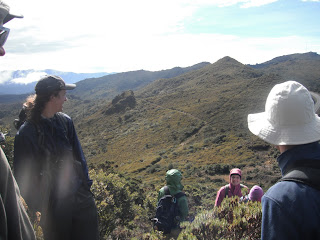
Classmates on a hill, with minimal clouds

Misty, eerie, and incredible, right?

We found another skink at the top, and took some more pictures of it.

Chesca, my tica BFF, and I at the highest point that we visited. It's like we're standing in front of a wall of clouds. You couldn't even see over the edge right behind us.
Coming down through the clouds

Miguel and my professor Susan on the way back to the car, though a bunch of grasses and flowering bromeliads
Justin, Chesca and I were the last ones back because we stopped to look at some sphagnum moss and listen to birdcalls.
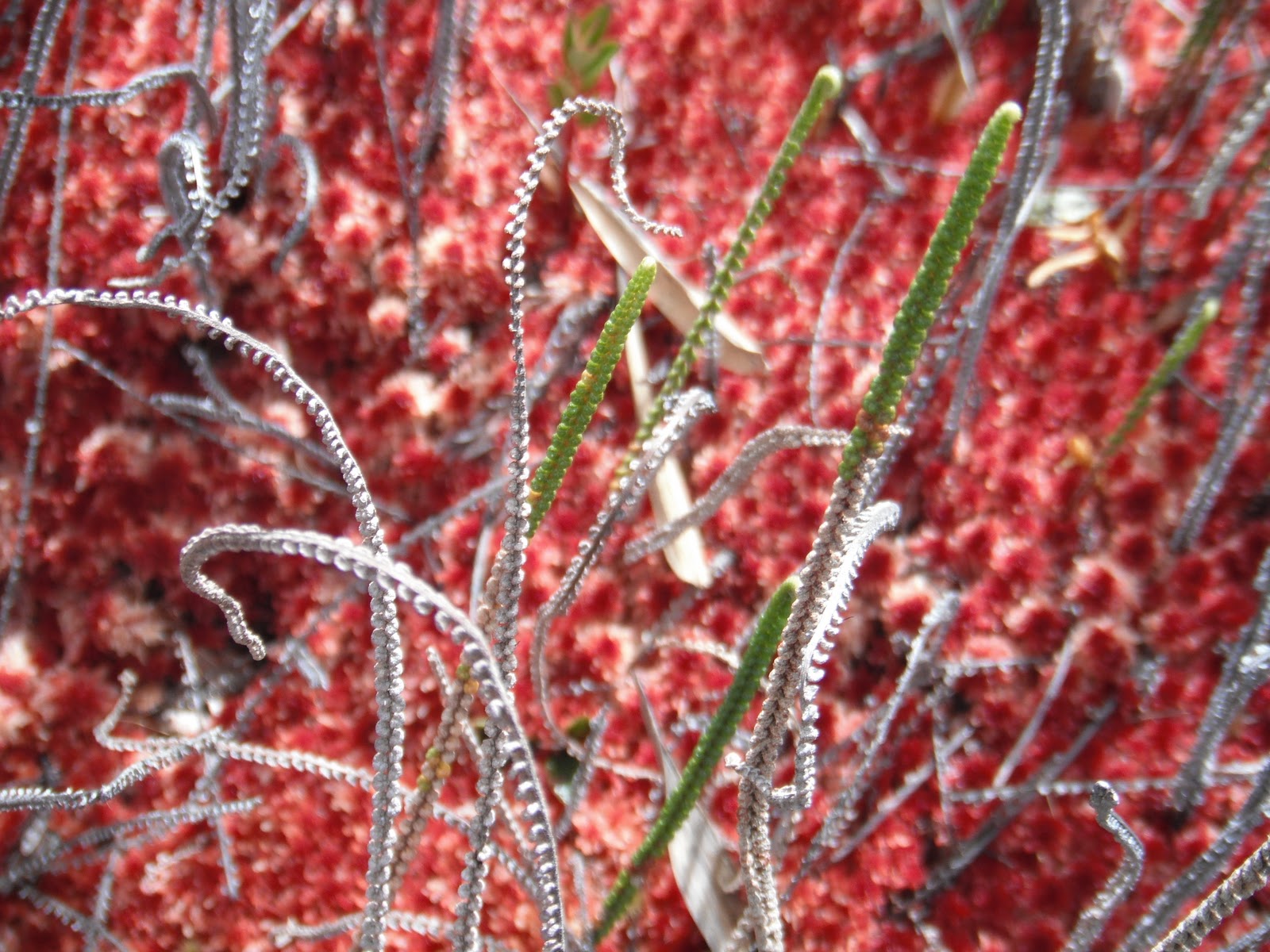
Sphagnum moss. Where water accumulates in the paramo, little boggy areas appear. Walking on them feels like walking on a memory foam bed.
We made it back down!
I know I said that the oak forest hike the day before was one of my favorite days in Costa Rica yet, but less than 24 hours later I think I exceeded my previous level of amazement already. The paramo is an incredible ecosystem that's totally different from any other place in Costa Rica; it's amazing that we could go from a relatively lowland rain forest to this bizarre, beautiful, almost alien environment in just a few hours!

Cuerici, pt. 1: The oak forest


Friday morning, we left Las Cruces and headed out for Cuerici. It was several hours away by car, and the big bus we took couldn't make it the whole way because the last part was on a steep and rocky dirt road. Don Carlos, the owner of Cuerici, and Don Alberto, his assistant, met us at the end of the road with a large truck that we loaded our big luggage onto, which was convenient because we didn't have to carry all of our stuff the last 5 miles to the station. As soon as we got there, it was pretty apparent that Cuerici is awesome. It's at a high elevation (~2,500 m) and in the Talamanca mountains, so the climate is way different from anywhere we'd been so far. It was sunny and breezy during the day, with misty clouds being pushed up the mountainside so that it feels slightly damp and cool all the time, in a good way. While it's still a wet forest, it's totally different than the forests we've seen before. Because of the higher elevation, the primary forest is a mix of oak trees and bamboo, with bromeliads and other epiphytes present but less common. Basically it looks kind of like a temperate forest, but more magical! Haha. 

When we first arrived, we moved our stuff in and had a brief orientation talk. Instead of having separate rooms like Wilson House at Las Cruces, the whole second story of the building was essentially one big room filled with bunk beds. There were thin dividers splitting the room into three rows of beds, giving us some privacy, but they didn't go all the way up to the ceiling so you could hear the people nearby even if you couldn't see them. In other words, there was not much privacy, which really wasn't a problem since we were only there for a week. It was kind of like being at summer camp since all 28 of us were in such close contact, which was fun.
My bed in Cuerici. I definitely needed the sleeping bag... it was COLD! Note: the top shelf is all of the clothes I have for the entire semester.
View from the bedroom window, looking down the mountain
The station, as viewed from the lawn
Patrick in a hammock chair on the front porch
Once we were settled, Don Carlos gave us a tour of the property. We started out going through the agricultural part of the land, where he grows things like vegetables and berries and grazes cattle. We also followed him briefly into the woods and got to see a generator that he built himself to harness some hydroelectric power for his house and the station. Then he showed us his trout farm, which is his main source of income (being the director of the biological station doesn't pay enough to support his family, so he does this on the side). It was really interesting to hear him describe how he manages the fish farm, from extracting eggs, hatching them, and raising them to preparing them to be killed and eaten. It was especially cool to learn about how he made his farm sustainable in various ways, like using old compost worms to feed the trout, and then taking sediment from the trout ponds and canals and using it back in the compost.

Some canals for older fish in the trout farm
That night we had a bit of free time, and a bunch of people wanted to watch a movie. I decided not to since I was already really tired (I hadn't gotten much sleep the night before while getting ready to leave Las Cruces!), and instead worked on a statistics homework assignment with Chesca and Miguel. We actually had a very good time doing our homework together, and it was nice to get the assignment done a week early.
The next morning, we split up into two groups again to be a more manageable size for talks. One group went out to the paramo (there is an accent over the first a, but I can't get it to show up on here), and my group went for a long hike up into the oak forest. We used the same groups that we'd formed for our visit to Don Roberto's farm, splitting based on Spanish proficiency. Don Carlos's talk was, therefore, entirely in Spanish. He is a very kind, thoughtful, and deliberate person, and I found him even easier to understand than Don Roberto. He took us through some secondary fores that he had restored from his grandparents' cattle pasture, which presently consists mostly of magnolia trees and alders. Then we entered the primary forest, which is made up largely of two species of oak and two species of bamboo.


Don Carlos talking about oak trees


The primary forest there serves as a corridor between other preserved areas, meaning that some large animals pass through there. Don Carlos said that peccaries, tapirs, and even pumas travel through the Cuerici reserve. I was surprised to hear that pumas were out there, since the only place we've been so far that is large enough for pumas to have territories was Las Alturas, which was contingent to a HUGE reserve (500,000 hectares). But, we actually saw puma poop while we were on our hike, so Don Carlos was definitely right, which is awesome!

Puma poop, full of peccary fur!
Bamboo forest!
After we had gained about 300 m in elevation, we arrived at a glorious lookout point facing the Talamanca mountain range. You could see a town down in the valley and watch the clouds pass between the mountains. It's hard to describe how beautiful it was, and even the pictures I took don't really do it justice.

The view from the lookout point, mancas
Orchids up on the mountain
After enjoying the view, we began to head back down to the station, stopping to talk along the way whenever Don Carlos saw something interesting. Overall it was an excellent way to spend a morning, and was probably one of my favorite days yet in Costa Rica.
Talking about logging, land management, and balancing human needs with conservation
An oak tree that's several hundreds of years old
Tiny Melastomataceae flowers