Showing posts with label Las Cruces. Show all posts

Sunday, February 20, 2011

Las Cruces, pt. 10: El Fin!

Thursday, February 10 was our last day in Las Cruces! It was hard to believe that our time there was already over, especially since two weeks is just long enough to really start feeling settled in. In the morning we had our plant practical, which was basically a test of our ability to identify the 20 plant families we had learned about while we were there. It took about 45 minutes, and then we had free time for most of the day. Our bug identifications were also due that afternoon, but I had finished them a few days before so I had lots of time to do whatever I wanted. I spent the day sitting out on the porches near the dining hall and catching up on some of the assigned readings that I was behind on. I also did some of the next readings in advance so I wouldn't have to worry about homework at Cuerici. It was a really peaceful day and I enjoyed spending some quiet time by myself and appreciating how gorgeous Las Cruces is before we had to leave. Some of my sights from the last day: 

Lots of birds on the deck!


My reader and some tea under the porch during a little rainstorm
We had one final lecture that night, given by a former undergraduate OTS student who's now working on his PhD in Las Cruces. He studies bats and gave us a really interesting lecture about their role in forest regeneration in Costa Rica. Afterward, a few other students and I walked out with him to look for some bats in an abandoned research shack where they nest. We saw a few, but since we were a larger group I think we scared most of them away before we even arrived.The coolest part of the whole thing was hanging out with someone who started out in the same program that we're in now, and seeing the interesting research he's doing now and how much fun he's having.

The rest of the night was spent packing up and getting ready to leave. It was a little sad because Las Cruces was so lovely, but I was definitely excited to explore somewhere new!

Friday, February 11, 2011

Las Cruces, pt. 9: Environmental Services Payments

After visiting Don Roberto's farm and having learned about the Costa Rican system that provides monetary incentives to individual landowners for conservation and reforestation, we had the interesting experience of helping out with a survey of landowners regarding their knowledge of, participation in, and satisfaction with Environmental Services Payments. Some representatives from CATIE, a Costa Rican NGO that studies agricultural issues, came out to Las Cruces and presented us with a draft version of a survey they hope to launch in a few months. All Tuesday morning we went through the survey to edit it and practiced asking the questions in Spanish. After lunch we broke up into small groups and went out to interview people. My group and two other groups took the OTS car into San Vito, since we each had a pre-arranged interview with one of three brothers that owned a farm together just outside of the town. Despite the fact that it's the dry season, it started POURING as soon as we got to San Vito. All 15 or so of us got stuck under a bus stop and had to wait about an hour for the rain to stop before we could head over to the farmers' house. 

Hiding from the rain under the bus stop.
 The surveys went relatively well, although the version we were using was still definitely a rough draft and it was a little awkward tag-teaming one farmer with a group of six interviewers that didn't speak Spanish very well. The whole event wasn't organized very well, but it really was cool to go out and hear people's real experiences with the ESP program. Marvin, the farmer we interviewed, was receiving payments for conserving forest, and overall seemed satisfied with the program. A lot of landowners that other groups interviewed had contracts to be paid for their conservation efforts but didn't receive the money they were promised. Some landowners had never heard of the ESP programs, and others knew about them but didn't have contracts because they didn't want to or didn't get approved. When we got back, we typed up our results, debriefed as a group, and talked about our experiences with the farmers and suggestions about the survey in general.

While out doing surveys, we also saw this cool tree that has red sap! Supposedly in the old days, people used it as toothpaste.

Las Cruces, pt. 8: Don Roberto

Our first day back from Las Alturas, we spent the morning visiting Don Roberto, a farmer that lives about 20 minutes away from Las Cruces. We went in two groups so that we could get a more intimate experience at the farm, and split based on Spanish ability so that our professors wouldn't have to translate everything twice. I was on the fence about which group to go in, but the advanced Spanish group had fewer people signed up for it, so I decided to go with them to try to even out the numbers. So, when we toured Don Roberto's farm, our whole talk was entirely in Spanish. I was a little nervous that I would be totally clueless since my Spanish is still rusty, but I think I understood about 80% of everything he said, so I was pleased in the end. 

Don Roberto owns a small farm, but grows a variety of crops. When we first arrived, he demonstrated how to extract the juice from sugarcane, which you can drink straight or ferment into cacique, a sweet liquor that is common in Costa Rica. We got to try the cane juice, but most of us thought it was a little too sweet to drink as is. According to Don Roberto's wife, he drinks about 4 liters of cane juice a day when he is working in the fields. Since it is basically just sugar water, I'm sure it keeps you energized!

Don Roberto (right) extracting juice from sugarcane, with his wife straining it and catching it in a pot.
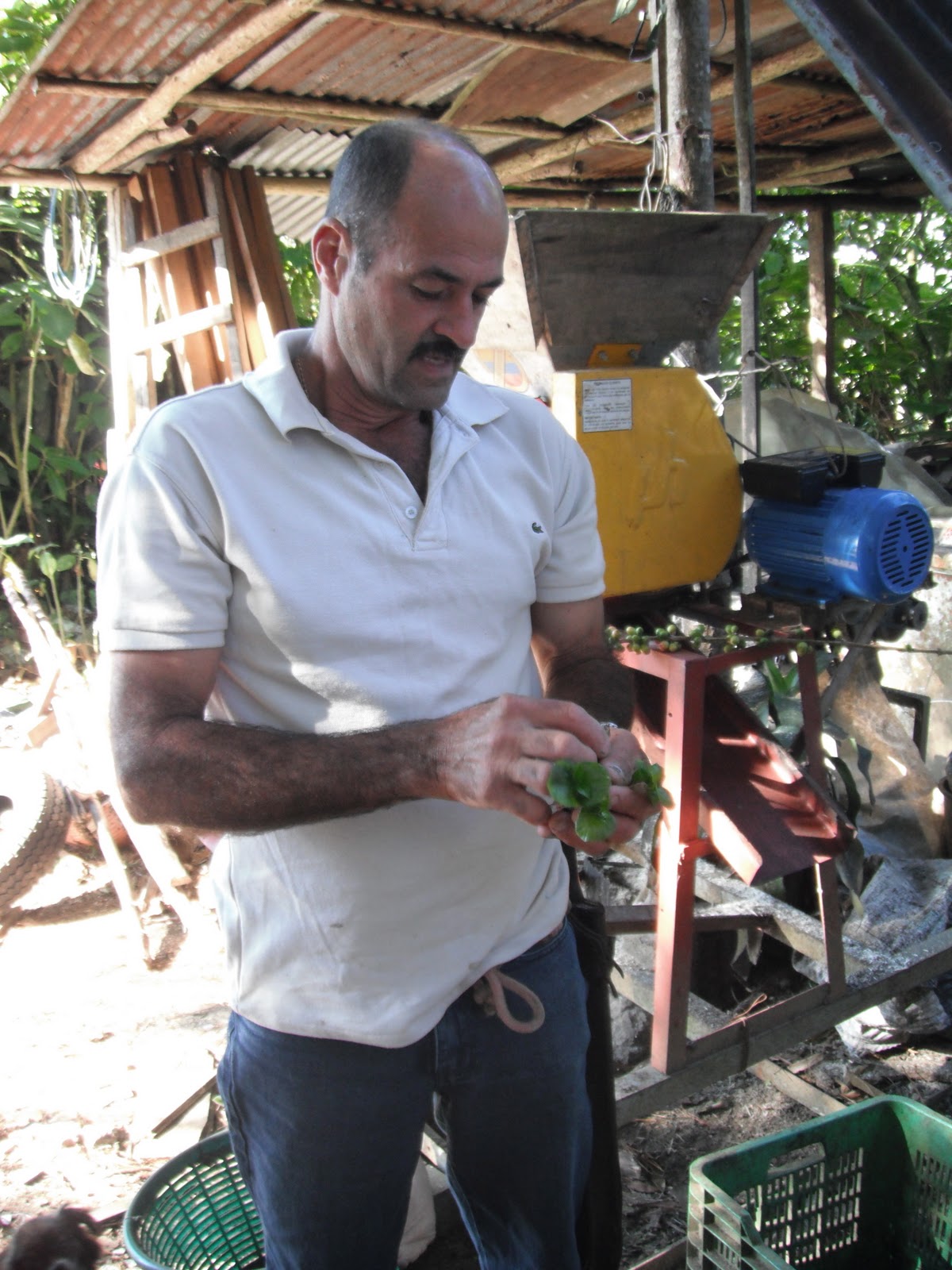
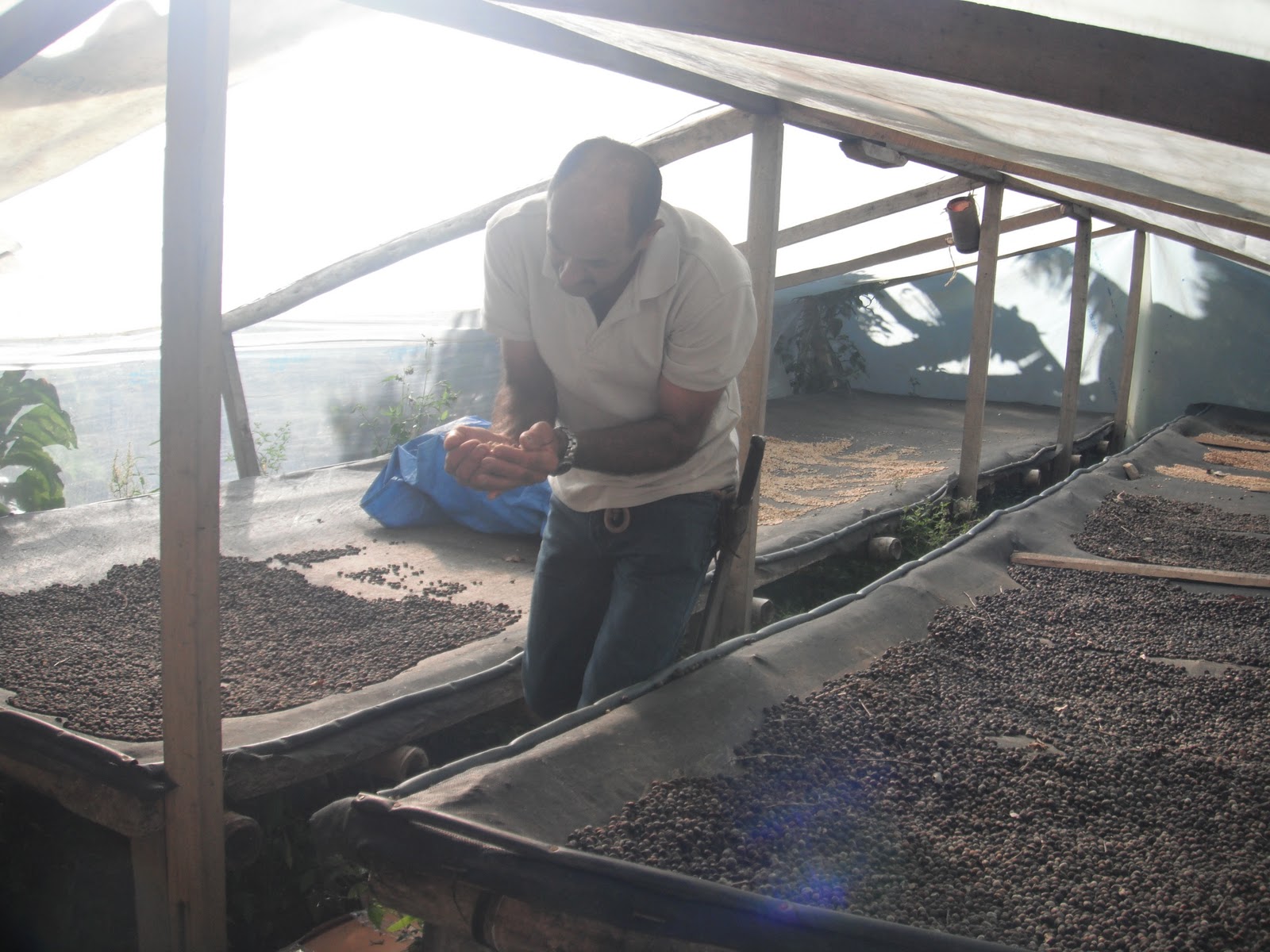
Don Roberto also grows a good deal of coffee, and showed us every step in raising, harvesting, and preparing it. It was pretty cool to see in person, especially since we had been learning about coffee in our classes.


Don Roberto showing us the different size coffee seedlings.
Separating coffee beans from the skin surrounding them.
Coffee beans drying in the sun.

At the bottom of his plot of land, Don Roberto keeps some forest. While he is not receiving Environmental Services Payments (which we have also been learning about in classes), he preserves forest on his farm voluntarily. He talked a lot about how his involvement with a co-op changed his perspective on farming (he now uses minimal pesticides and herbicides, and composts to cut down fertilizer needs) as well as conservation in general. He used to use the forested land to graze cattle, but about 18 years ago decided to let the area regenerate naturally. Now it is a nice patch of secondary forest, which helps protect the watershed and provide habitat for animals. It was really interesting to hear how his perspective had changed over time and how important he felt that maintaining a balanced and well-informed personal mindset is on allowing people to both make a living and be environmentally conscious.


A field of beans

Las Cruces, pt. 7: Forest fragment fun

Thursday morning (2/2) we started the day early and drove out as a group to a pasture about 20 minutes from Las Cruces. As in many parts of Costa Rica, the land here had been cleared of trees to graze cattle; however, areas with steep slopes or otherwise difficult features were left untouched because they're more trouble than they're worth to clear. This leaves a bunch of forest fragments behind, which we went to see. 

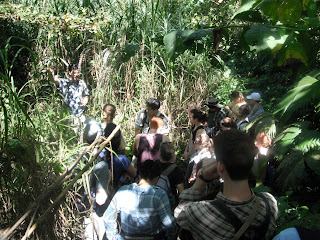
Susan, our professor (center, back row), teaching us about fragmentation.
 While it's good that some areas of forest are left behind when land is being clear-cut, fragmentation still has lots of negative effects on forest ecosystems. By creating lots of extensive edges that would not exist otherwise, fragmentation alters microclimate, species composition, and species interactions in forests. For example, an "island" of fragmented forest can become sunnier, warmer, drier, and breezier up to 10 m in from the edge on all sides. As a result, animals and plants that rely on shade or canopy cover for food or to avoid predation have even more of a reduced habitat than they already did due to the initial fragmentation. Furthermore, the altered microclimate can be favorable for species of plants and animals (as well as diseases) that normally wouldn't be a part of the forest ecosystem. These invasives can outcompete the existing flora and fauna and exacerbate their local decline. Fragmentation also tends to decrease gene flow between previously contiguous forest patches, generally decreasing the fitness of isolated populations. Basically, fragmentation is not good!

Classmates walking through the pasture after visiting a fragment of secondary forest.
The site of our field trip. You can see how the clear-cut land borders up against a fragment of primary forest (left).
After getting to explore the pasture and remaining forest patches and experience the effects of fragmentation firsthand, we sat down and did another field writing exercise, this time about how fragmentation would effect a species of our choice throughout its life cycle, including growth, food acquisition, predation risks, and reproduction. When we finished our writing, we got ready to head back to Las Cruces.

By the end of the exercise, the fog had begun to creep in! It looked pretty cool blowing around in the valleys.
While we'd taken two OTS trucks out to the pasture, one had just dropped us off and returned to the station. This meant we only had one car on the way back, which was definitely not big enough to fit all 28 students, plus our two professors, TA, and driver. We planned to do shifts, driving some people back each time, dropping them off at Las Cruces, and then returning to pick up more. Because it was a beautiful day, I decided to walk most of the way, and was rewarded with amazing views.

Enjoying the scenery while headed back towards Las Cruces.

After lunch, we had a lecture on forest classification, and learned to identify different forest ecosystems using the Haldridge Life Zone system, which based mainly on latitude, altitude, and precipitation. It finally made sense why our professors kept referring to the forest as a "Tropical Premontane Wet Forest" instead of just a rainforest! Haha.

A chart of the Haldridge life zones. (Click to enlarge.)
Friday was a relatively average day, with a review of statistics in the morning, a tutorial on how to use JMP in the afternoon, and a lecture about beetles and flies in the evening. Since I took statistics at Reed already, am totally comfortable using JMP, and am not particularly into studying insects, I was a bit nonplussed with the combination of three uninteresting things into one day. Plus, we had essentially no physical activity, either, so after our statistics workshop Tessa and I decided to be motivated and go for a run, which turned out to be fun and also (unsurprisingly) very beautiful. So far I've been hard pressed to find a place in Costa Rica that I don't think is beautiful. Haha. Friday may not have been the best day, but we ended it by packing for an overnight trip to a new field station!

Las Cruces, pt. 6: Rio Java/Cafe Mocha

After our first rest day, we were right back into the swing of things, and were busy again with lots of schoolwork. We spent Tuesday morning out in the field with our professor Susan, learning how to identify nineteen plant families. Later that day, we had a lecture from our other professor, Erika, on her research. She studies the mating system of Heliconius butterflies, which is unique because the male butterflies compete so fiercely for mates that they sit on the pupae of developing females so that they can mate as soon as (or sometimes even before) the female emerges as an adult. She told us about several interesting experiments that she's done, which are particularly cool because they seem to demonstrate opposite selection on two traits, body length and wing size, that are correlated with each other, so the selection effectively cancels itself out (although this family of butterflies also seems to have evolved a different body size ratio than other closely related families as a result). 

On Wednesday, we started the day with another hike out on the Rio Java trail, where we went for our first observations, and then accidentally when trying to find the waterfall on our rest day. We hiked out farther than before this time and dispersed ourselves along the trail to do another observational exercise. Instead of just soaking in the incredible surroundings, this time we were assigned to describe as many plants as we could in our field notebooks. We had about 30 minutes, which feels surprisingly short when you are trying to notice and record as many details as you can about a plant you've never seen (or at least paid such close attention to) before.

One of the plants I tried to describe had weird bumps on the leaves, which I think were caused by some sort of insect.
 After finishing up our observations, we began to head back to the station. I was near the back because Tessa and I were trying to practice identifying the plant families we'd learned the day before. With help from our TA, Daniel, we started to get the hang of recognizing the key traits of each family.

A large strangler fig (family Moraceae; above) and some cool vines (below) on the trail.

By hanging towards the back of the group and taking our time, we also got to see some cool and unexpected wildlife. First we saw a tarantula, which we thought was dead because it wasn't moving at all. After we spent a few minutes poking at it, we realized that it was actually alive after all! Then it decided to pose so we could all take pictures.

The tarantula was surprisingly cooperative!
Shortly after encountering the tarantula, we passed a huge strangler fig (similar to the one in the photo above). On the hike in I had noticed that there was an unusual and unpleasant smell near the tree, but I wasn't sure why. Our TA came in handy again and told us that it was the smell of... bat feces! Strangler figs start out their life cycle as vines that climb up the trunks of existing trees, eventually reaching the canopy and putting out leaves. With time the vines can outcompete the host tree for light and nutrients, causing it to die. When the host tree rots, the strangler fig is left like a hollow shell and continues to live independently. The strangler fig we saw was almost entirely hollow, and there were dozens of bats living inside! We pulled out a flashlight, stuck our heads into the tree, and looked up, only to see lots of bats hanging upside-down above our heads. After a few minutes of examination the bats started to wake up and move around, so we left. Unfortunately I couldn't get a good picture because it was too dark. Our last interesting sighting of the day was a lizard, which was pretty well camouflaged but I managed to get a decent picture of anyway!


That afternoon we had a lecture on Costa Rican geology, and how topography dictates the climate and weather patterns that allow for such a diversity of ecosystems in the country. Later we watched a short documentary about coffee production in Central and South America, which had economic and anthropological themes in addition to ecological information. Point of story: most of the time, farmers get screwed because of market fluctuations and the time delay before they can alter their crops in response to changing prices, and buying fair trade coffee is really the only way you can assure that the money you're spending is reaching the hands of the people who deserve it. While the concepts weren't necessarily new, it was interesting to get a more detailed look into the processes of coffee cultivation, processing, and sale.

Our last activity of the day was a lecture about forest fragments, to prepare for a field trip on Thursday morning!

Tuesday, February 1, 2011

Las Cruces, pt. 5: Rest day

After fruit lab ended, our "weekend" finally began. Because we move around so much during the semester and are incorporating lectures, lab work, AND field work into everything we learn, our days are jam-packed with activities. To make the absolute most of our time, we don't actually have weekends off. Instead, we have one "rest day" every ten days or so. By the time Sunday night came along, we were all more than ready for a break from school, which keeps us busy virtually all day from 6:30 am to 9:00 pm.

We decided to go into San Vito, since we had only spent about 45 minutes in town earlier in the week to buy our rubber boots, and also since we hadn't really left the field station at all during the prior seven days. Luckily we were well-fed after fruit lab, because we stayed out until after 1 am (this is REALLY late considering our typical daily schedule!) dancing at a bar in town. 27/28 of the group went out (this required 5 taxis, which was pretty funny to organize) and everyone seemed to have a good time. I had a lot of fun just dancing and relaxing and not worrying about having to wake up early the next morning.

Me and two of my roommates at the bar... The dancing had not yet begun, which you can tell by the fact that we aren't super sweaty!
The next day we slept in until 9 am, which comparatively felt like a real luxury! It also meant that we missed breakfast, though. I spent the morning re-organizing my part of the room and getting a load of laundry together to be done. Around 10:30 I set out with three of my roommates on a dual mission: to collect bugs to identify, and to find a waterfall where you can supposedly swim. Neither parts of the mission went exactly as planned, but probably for the better. We found 4 or 5 insects to potentially ID, which was a fair amount but not as many as we had intended to collect. However, I liked the fact that we weren't too focused on the assignment, since we just got to enjoy our hike instead. After a while, we forgot that we were even carrying around our bug net!

A blue morpho butterfly that we ran into on our hike. We were unsuccessful catching it to ID, but we did get to watch it fly around for a bit. It's large (about 5" wings) and the other side of its wings are bright blue!
We also never found the waterfall, which turned out to not be our fault. The professor that we had asked for directions the day before told us the complete wrong way to go, so we hiked an entirely different trail than we should have. Again, this ended up being a good mistake because even though we didn't find the waterfall we found an excellent place to swim. We walked upstream a little bit from the river we crossed earlier in the week and found a pool about four feet deep and ten feet wide, so we actually got to go in the water. Other students who actually made it to the waterfall said that it was a nice looking waterfall but the "pool" at the bottom is actually only about 6" deep so you can't actually swim in it.

We brought bag lunches out to the river and ate by the pool.
Tessa holding her lunch container, saying "Hi, Mr. Cott!"
Stephanie in the pool we found.
 Overall we ended up having a nice hike, lunch, and swim. It started to rain while we were out so we headed back around 1:30. After we got back to Wilson House we all showered and changed, and then hung out until 4 pm, when we took the OTS jeep into San Vito. Since it was our day off, professors generously offered rides into town every two hours throughout the day. I took the last ride in with 9 other students so we could walk around the town a bit more and then go out for dinner. We wandered around the town for a bit, looking in shops and stopping at the grocery store to get things to bring back to the station, and then went to an Italian restaurant for dinner. Although the food at Las Cruces is excellent, it was still really nice to go out for something different for one night. We got three pizzas and three salads and shared them between the ten of us.

Group photo at the pizzeria.
The dinner was a nice opportunity to hang out with each other in a non-academic context and get to know each other a little better. Since we've been spending every waking moment together, I think we all occasionally forget that we've only known each other for a week and that there is still so much to learn about each other. We got back to Las Cruces around 7:30 and, at least in the Armadillo room, were all asleep by 10, exhausted from activities even on our day off. It was really really nice to have a break from classes, though, and get to whatever we wanted to, at our own pace. I definitely feel refreshed and ready to learn more!

Las Cruces, pt. 4: Bugs, flowers, and FRUIT!

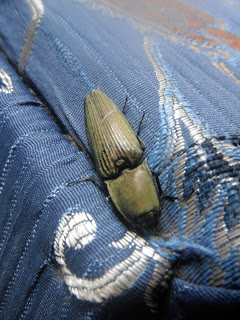
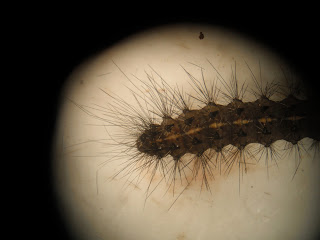
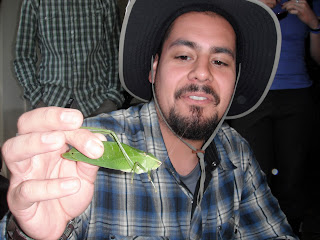
Since Friday, most of our classes have been about taxonomy. Saturday morning we had a class on insect taxonomy in which we learned how to identify characteristics of insects that will help us figure out which insects are which. We also went through a review of lots of orders of insects and discussed their basic features. After the lecture, we had a brief field exercise that basically consisted of us pairing up and wandering the gardens armed with nets and plastic bags, looking for insects. After about an hour of bug-hunting we went back to lab, examined our findings, and tried to identify them using what we had learned earlier in the day. Luckily we had packets with descriptions of each order in them, because it was very difficult to recall all of the extensive information we were presented with off the top of our heads. Some cool insects I have seen so far at Las Cruces
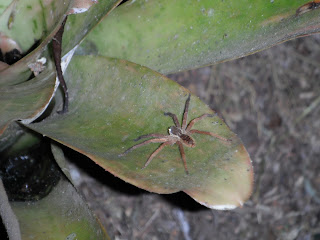
A spider I saw hanging out on a bromeliad in the garden at night.
A beetle that was living in Wilson House for a few days
A caterpillar that we used in our insect ID lab, as seen through the microscope.
Manny, a classmate, holding up a cool insect that we found while putting on boots before a class one afternoon.
During the insect lab, we also received our first real assignment of the semester: we have to find and identify 10 insects to the family level. Insect identification is hard enough to do to the order (since I didn't really know anything about them before this course), and identifying them to the family is even more challenging. Once we think we have identified them correctly, we have to show the insect to our instructor, Mau, and have him check it. We have to repeat this assignment three times throughout the semester, once at each OTS station we stay at (Las Cruces, La Selva, and Palo Verde). For the first two, we have unlimited attempts to correctly identify 10; i.e., even if you get twelve wrong in a row, you can keep trying until you get a total of 10 right. However, at the last station, we only have a total of 10 tries to get them right, and will be marked down if our identifications are incorrect. It takes at least an hour to identify each insect, so far I have only done one, and we are only at Las Cruces for about another week. That means that I have a minimum of 9 hours in lab in addition to my normal classes before I leave!

Saturday afternoon we had a class specifically about Lepidoptera, the order of insects in which butterflies and moths are classified. Erika, one of our professors, studies Heliconius butterfly mating, so she taught us a lot of cool things about different families of butterflies. After dinner we had a class reviewing the basics of the scientific method and experimental design, since not everyone in the program is a science major. We also got our second assignment of the semester, which is about scientific ethics. There are four topics of discussion that students will give presentations and lead discussions about throughout the semester. My topic is about data manipulation in science, and my group won't be presenting for a few weeks so we haven't started working on it yet.

In our free time before dinner, I unexpectedly ended up playing soccer with some of my classmates. It had rained (hard) the day before, so the field was muddy, which eventually meant that I was muddy. Although I don't normally play soccer, I actually had a lot of fun, and my team won!

After dinner on Saturday we had a lecture about coffee in Costa Rica, since it is such an important crop here. I thought it was very interested because the agricultural, social, economic and political aspects of its cultivation and sale are so tightly intertwined. And, of course, since it's a widely-grown crop, and also a processed product that produces waste, we talked about it from an environmental perspective as well.

Sunday morning we began the day with a talk by Zak, the director of Las Cruces, about tropical restoration ecology in general and the restoration projects here at Las Cruces specifically. We then hiked out to the edge of Las Cruces to Melissa's Meadow, a site that is currently undergoing restoration since, as its name implies, it used to be pastureland before the land was purchased and added to Las Cruces. They are letting parts of it reforest naturally, and also using sections of it to do studies comparing different restoration strategies to see which are most effective.
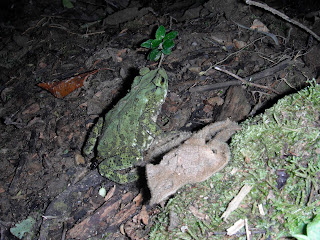
A frog we ran into on our way out to Melissa's Meadow.
The class on the border of the primary forest (left, dark and shady) and the former pastureland which is now secondary forest (right, more sunny because there are fewer old trees).
All the way out at one of the research sites, where they are comparing methods of restoration. This part was less advanced than other conditions, which you can tell since there are lots of grasses and few trees. A more restored patch is on the right, which is why there are some overhanging branches.
After our trip out in the field we had a lecture about floral morphology. We learned a bunch of vocabulary about flower anatomy, and then had a lab in which we dissected plants and identified their parts.
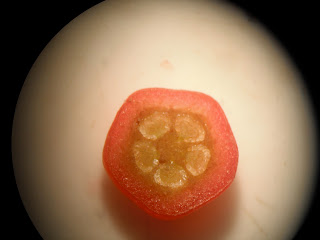
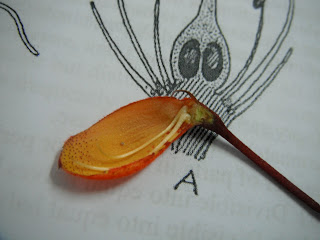
A cross-section of a flower ovary, as seen through the microscope.
A longitudinal section of a flower (Columnea spp.)
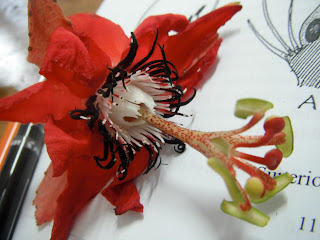
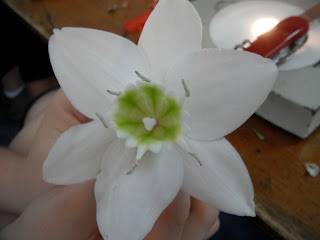
A Passiflora bloom. It was almost too pretty to cut apart... but we did it anyway.
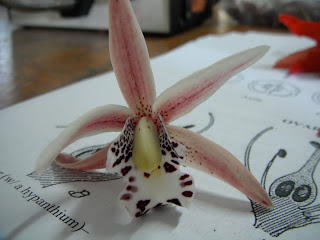
An orchid. This one was actually too pretty to cut apart, so I kept it. Haha.
Another longitudinal section of a flower with a long tube leading down to the nectar. Flowers like this need pollinators like moths or butterflies with long probosces to reach all the way down there.
Another one that was too pretty to cut up!
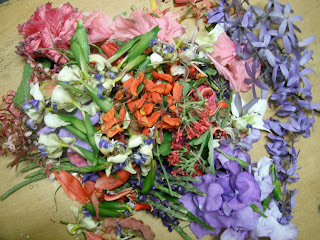
The aftermath of the floral morphology lab
Later that day we had another plant morphology lecture, but this time about fruit. Like the other taxonomy and morphology lectures, it was chock full of information and difficult to absorb everything at once. However, the fruit lecture was extra fun because instead of having a dissection lab, like we did for flowers, or an ID lab, like we did for insects, we had an only semi-educational but incredibly delicious tasting lab for fruit. Unfortunately I didn't bring my camera to that event, but our professors cleared off the tables in lab and arranged them in a rectangle with plates and plates of different kinds of fruit. We made our way around the table stopping at each station to try the fruit, and describe the taste, color, smell, and texture. There were lots of awesome fruits that I had never tried before (guanabana, chayote, tamarind, cas, starfruit, sweet lemon, and others), two that I didn't like (papaya and noni, a disgusting fruit that smells and tastes like vomit, and is jelly-like in texture... only one person in the entire group could even swallow it!), and of course a bunch of familiar favorites (kiwi, pineapple, mango, coconut, sugarcane, lots of berries...). The "lab" was basically a dessert party, and everyone seemed to have a good time. Plus, Monday was our first day off, so it was a really nice way to begin our "weekend."
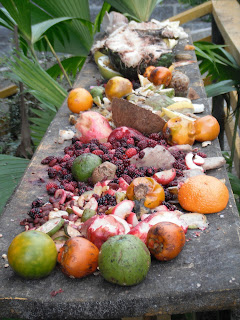
The leftovers from fruit lab, which we left out for the birds.

Las Cruces, pt. 3: Welcome to the jungle (literally)

By Friday (1/28), I was beginning to feel more settled into the daily routine at Las Cruces. Every day we wake up around 5:45 am (even if my watch alarm doesn't go off, which is happens surprisingly frequently, I've been wide awake without fail), and begin breakfast at 6:30. A typical breakfast here is rice and beans, scrambled eggs, some sort of bread or baked good, and fresh fruit. Most everyone also drinks coffee in the morning (and throughout the rest of the day) because a) the coffee here is excellent and b) it helps us stay awake during all of our activities. Our first class is either at 7:30 or 8 am, so if we finish breakfast quickly we have time to go back to Wilson House, where we're living, and do things like review readings for class, check email, finish getting dressed, etc.

On Friday, we started the day out with a hike into the forest. We usually do our outdoor activities in the morning, because it is more likely to rain in the afternoon (and, in my opinion, because we are all more likely to fall asleep in class if we are sitting around in a classroom so early). Believe it or not, that hike was everyone's first time being in the actual forest, since all of our previous field activities had been centered around the botanic gardens, which is obviously managed and landscaped in a way that the actual rainforest is not.

We hiked out on a trail and crossed a small river (our rubber boots got a muddy christening), after which we split up and went off to find a place to sit alone. Since it was our first experience in the rainforest, our only assignment was to remain in one place for about 45 minutes, observe our surroundings, and write down what saw/smelled/heard/felt/thought. I really appreciated this assignment, since it gave us a chance to really get a feel for the amazing place that we're lucky enough to be living without being distracted by trying to learn yet.

A strangler fig on the trail towards where we made our observations.
Flowers near the river. If you look closely, you can see Tessa's head in the background. Haha.
I would say the most amazing and unexpected thing about the rainforest is the sound. You don't realize it so much when you're hiking around, but as soon as I sat down the only thing I could focus on were the layers and layers of constant sounds permeating the forest. Because of the dense foliage, you can actually experience more by listening, since you can hear things you can't see. The cicadas and other insects make a loud baseline hum that pulses through the air, getting louder and softer in constant cycles. On top of that you can hear birdcalls in the distance at all times, even if you can't make them out specifically. On top of that are the birdcalls that are close enough to really hear. Then there are the sounds of falling leaves (and, once, a falling branch) and other rustling things (small animals passing by) that are surprisingly loud and almost startling to hear while sitting in the relative "silence". At one point I heard a loud buzzing sound and thought there was a large wasp coming to sting me, but it was actually a tiny hummingbird that flew right up to me and checked out the red bandanna that was sitting on top of my backpack! That was very cool.

Once I got over the sounds, the second most obvious thing that I sensed was the humidity. After about an hour of hiking, the last bit of which was steeply uphill, I was very hot. I could feel my pulse clearly in my temples. Even though the temperature here is not unbearably hot, it's very humid so your sweat doesn't evaporate quickly at all. Overall, once you begin sweating there is a somewhat constant feeling of warm dampness. I was dripping with sweat, which is why I had my bandanna out to wipe off. Only after processing the sounds and the feelings did I actually begin to notice the appearance of my surroundings. The only way to describe what I saw is overwhelming greenness. In the rainforest, you see every shade of green imaginable. There are trees everywhere and the canopy is so thick that less than 1% of sunlight actually penetrates to the forest floor. Because the light is so diffuse and there are so many plants, it's almost like the forest glows green. It is beautiful. In my opinion, the other most prominent visual feature of the rainforest is the layered-ness of all the living things. Everything, living and nonliving, is covered in some other living thing. The ground is covered in moss and ferns and understory shrubs. The trees that make up the canopy create a green ceiling above. The trees are covered in epiphytes (plants that grow on other plants)--bromeliads, vines, and lianas--that use the trees' height to get closer to the limited sunlight. The leaves of all the plants, trees, shrubs, herbs, and epiphytes alike, then have epiphylls (moss, algae, bacteria, lichens, or other organisms that grow on leaf surfaces) living on them. Many of the plants have close symbiotic relationships with insects, and have entire microhabitats associated with them. For example, bromeliads that grow high up in the canopy on the trunks and branches of trees collect water in between their leaves, making little aerial pools where insects and little frogs can live. The complexity of the adaptations and the extreme interconnectedness of all the living things here is really astounding.


A (blurry) bunch of fellow students near the river after we returned from observing.
A cool partially decomposed leaf we found on the hike.
After getting to soak in all these observations of my new home, we regrouped and hiked back to the station. We had a discussion of rainforest structure afterward, using our observations to put the concepts we discussed into context. After lunch we had our first taxonomy class, which was about plant vegetative morphology, a bit of free time, dinner and then another lecture about Costa Rican history. Our day finally ended at about 9 pm, and, since we get up so early, bedtime is reliably between 10 and 11. This was great way to start off our stay at Las Cruces, since up until now most of the activities we did were sort of introduction/orientation-type things. I definitely feel comfortable here and love the fact that I get to spend a good portion of every day filled with awe in my new surroundings!