Showing posts with label Agriculture. Show all posts

Wednesday, April 20, 2011

La Selva, pt. 1: Going bananas

After successfully hiking out of San Gerardo, we took the bus back to Calandria and stopped for showers and an early lunch before continuing the ride out to La Selva. We arrived at our destination just in time for dinner; La Selva is in the lowlands of northeast Costa Rica, so it was several hours of driving to get out to the final field station we'd inhabit during the semester. After dinner we had time to settle in to our rooms. Since we had switched up the usual roommate situation at Monteverde, and since we would be parting ways in just a few weeks, we made sure to room with our favorite amigos. Tessa, Steph, Chesca, Francesca, Rukhshana and I snagged a room for six with (gasp!) a private bathroom! All of the other rooms in our bunk had shared bathrooms located in between bedrooms, so we were pretty excited to have one to ourselves. 

Even though we didn't have any serious activities planned for the first night, we could immediately tell that La Selva was quite different from Monteverde in many more ways than just climate and ecosystem. First of all, the station was HUGE, and had multiple buildings. It is better described as a campus than a single station, I guess. At Monteverde, everything was self-contained in the one tiny, quaint building. There are always lots of scientists at La Selva, so it's bustling with people, compared to the relative solitude we experienced at Monteverde, Cabo Blanco, Cuerici, and even Palo Verde (although it's also a bigger station, it's one of the less sought-after destinations for many biologists and tourists). In fact, when we arrived at La Selva, the first thing we saw was a large group of younger-looking students, and we soon realized that we would be sharing all of our meals and common spaces, for the first week of our stay, at least, with a high school tour group. That certainly was a switch! Also, this was the first place we stayed with real labs, since researchers stay there for months at a time conducting complex projects. Thousands of papers have been published by scientists who have lived and worked here. I began to think of La Selva as, comparatively, a swanky hotel for field biologists. We assumed that the semester was planned for us with La Selva as the last stop in order to make re-entry into the "real world" a little less harsh.

The next morning, we had an orientation hike around parts of the reserve. To add to the stark contrast to the previous field stations we stayed in, we quickly discovered that the trails at La Selva are all paved with concrete. This seemed pretty weird and "unnatural" at first, but it turns out there are so many visitors to La Selva (and so much RAIN) that paving the pathways helps to keep human-induced erosion minimal and minimize the amount of maintenance required on the trails. Also, there are stakes planted throughout the whole property at 50 m intervals, so you can precisely identify where you are at any time. Every trail has markers at .1 km intervals with both the distance and trail name, so you can easily find your way around (as long as you know the codes for the trails) and estimate how long it will take you to get back from wherever you are. Pretty convenient, but, again, surprisingly "managed" compared to other sites we'd seen.

The class hiking around on a paved trail at La Selva
An eyelash pit viper on a tree
Our walk was brief, only an hour or so, and was more to tell us basic facts about La Selva than to see a significant part of the property, which is HUGE.  We did, however, get acquainted with two or three of the main trails and saw lots of cool plants and animals even in the short time we had. After the general orientation walk, we had a plant walk with Susan to start learning our new group of plant families for the site, which we'd be quizzed on later in our stay. At the end of the plant walk, we were crossing the iconic bridge over the Puerto Viejo river, and we were lucky enough to see tarpin down below! I wasn't able to snap a picture in time, but it was amazing to see these giant, frugivorous fish which are rare because they are so good to eat. Susan was especially excited, because in all of her years coming to La Selva she had only seen them one other time.

The iconic bridge at La Selva
In the afternoon, we had time to start developing IP ideas, which really meant we just had free time to walk around and explore. Later, we had a cool lecture on neotropical mammals. After dinner (which we ate quickly to avoid having to spend too much time around loud, hyper high school students) we decided to walk a few km to the nearest bar to check it out. While we've had to be careful at all of the sites we visited, La Selva is particularly dangerous because of the high frequency of venomous snakes in the region. Particularly, there are lots of fer-de-lances (terciopelos in Spanish), which are exceptionally aggressive snakes, and will strike without even being threatened. As Mau described it to us, if three people walk by a terciopelo, the first one will alert it, the second one will annoy it, and the third one will get bitten. So, on our excursion into "town" (really just a bar on the side of the road leading up to the station), we all wore our thick rubber boots to make sure our feet would be safe from snake bites. We affectionately called our trip "bitches in boots night"because (a) we were mostly ladies, (b) we got dressed up, and (c) we were wearin' our snake boots. It was a fun night, although the bars were pretty empty because, coincidentally, it was Palm Sunday. Oops!

All ready for bitches in boots night!
The next day, we had a free day. Because we had just arrived and still hadn't seen much of the property, we spent it pretty casually. For one of the first times in the semester, I slept through breakfast and spent the day lounging around the bunk with my roommates. Also, I did laundry, which was exciting in prospect but turned out to be pretty ineffective... while our clothes came out objectively "clean" (i.e. no dirt), they still smelled exactly the same way they did when we put them in, which was certainly not very good. Luckily at this point we were all pretty used to being dirty and smelly around each other, so it wasn't a big deal.

On Tuesday, we took a trip to a Dole banana plantation. While we had a reader with lots of articles in it, the only actual book we needed for our OTS course was called Breakfast of Biodiversity, and talked a good deal about the banana industry in Costa Rica and its effects on, well, biodiversity. So, a trip to a commercial banana farm was quite appropriate, and also a nice switch to the usual activities that we did.

A Dole employee describing how bananas grow
Ashur demonstrating how bunches of bananas are harvested. First, foam pads are placed in between the individual rows of bananas (called "hands") to minimize the inter-fruit squishing. then they are bagged up, and one worker uses a machete to chop the whole bunch at the base. Another worker, below the bunch, catches them on his shoulder (also protected with a pad) and hauls them to a conveyer-type that transects the whole plantation and brings the bananas back to the processing plant.
Banana processing!
Since it's a food plant, we had to wear hair nets. We look like lunch ladies.
Checking the bananas to make sure they're healthy
Bananas getting washed and floating across the factory
Employees brush the tips of the fruits with alum to prevent rotting. It's toxic! Yum!
The tour ended with all of us receiving free Dole stickers and a shot of banana liqueur. It sounded good in theory, but was actually disgusting. Sickeningly sweet and very very strongly alcoholic...

After our tour was done we returned to La Selva, had lunch, and then had another lecture about bananas! This time, though, it was from an academic/scientific perspective instead of the commercial one we got at Dole. As it turns out, bananas are very political! (Seriously, search the history behind the term "Banana Replublic.") We also had a group discussion about the book we had read, and then had dinner. While the facilities at La Selva are nicer because of the number of people who visit it (and the revenue they bring in), unfortunately the food was not as good as that at other stations since the cooks were preparing meals for so many people simultaneously.

Following our lackluster meal, we met one of our visiting professors: Cesar Nufio from UC Boulder. He studies grasshoppers and climate change, and is also a curator at a natural history museum there. We also had the last of our ethics discussions, this time on first world/third world interactions in science. Once all of our classes were finally done, we went to sleep, ready to begin our faculty-led research projects the next day!

Monday, April 4, 2011

Spring Break, pt. 2: Global Creek

So, as I mentioned in the last post, the house we rented for spring break was, unbeknownst to us before arriving, located on a 13-hectare organic permaculture cacao farm called Global Creek. Throughout our five-day stay there, we learned more about exactly what was going on there, and even ended up doing some volunteer work at the end of the week.

So, Global Creek started out in a different location on the Caribbean coast of Costa Rica with Ahki, the current manager of the property in Cocles. He graduated from college in Canada and, after working for a while helping businesses become more sustainable, came to Costa Rica to do volunteer work at some places that had reputations of being very ecologically-conscious and sustainable. When he arrived, however, he says he was disappointed in the discrepancies between how the places were marketed to people and how they actually operated. Thus, the idea for Global Creek, a sustainable business that integrates permaculture, sustainability, environmental education and "life learning," was born. He met someone with some extra land that Ahki began to watch and develop the business plan. Somewhere during that time the owner of the current Global Creek property found out about Ahki's business and mission and invited him to manage his piece of land. The owner built three houses on the property... one for Ahki to live in, one for a couple from the U.S. that processes the cacao and makes gourmet chocolate, and one for volunteers to live in while working on the farm. The last house is the one we stayed in, because they rent it to vacationers in between volunteer groups. 

The reason we couldn't rent the house for the rest of the week was because the property owner's daughter and sister-in-law were coming down to Costa Rica. They originally were supposed to be interviewed for a news documentary about sustainable business, but the filming got postponed until later this year and they decided to come down anyway since they had already booked their flights. The owner's family was only using the second-floor apartment, though, so the downstairs (where my bedroom was) was still available. There is also a "jungle hut," aka a screened-in platform with three beds on it, near Akhi's house. These were the two places we were allowed to stay for our extra time. The deal Ahki offered us was to continue staying on the property for free for as many more days as we wanted, as long as we helped him out 3-4 hours a day since they were in between volunteer groups. Normally even volunteers have to pay $5 a night to stay, so this was an extremely generous offer for him to make! 

The first day, we all stayed over together. Some people payed their way by working on the farm, but I helped thoroughly clean the upstairs apartment to prepare for the arrival of the next guests. I was planning on staying another night afterward and then going to Cahuita, a beach 30 minutes north of Puerto Viejo, for the last day. However, I checked my email after cleaning the house and saw that Chesca wanted to meet us in Cahuita and that she was already there with her boyfriend and was only staying until Saturday morning. I decided that I would take the bus to Cahuita at 2 pm on Friday to try and catch Chesca before she left, and volunteer in the morning even though I wouldn't be staying over another night. Because I had talked to Ahki about it already and because I was curious to learn more about the cacao farm, it felt like a reasonable way to do that without standing up Chesca. 

So, Friday morning I got up early and met Ahki at the rancho to start working. A few other people were staying to volunteer, and the rest left for Cahuita early that morning. We split up the tasks, but in the first hour or so I got to hear a little about all the different projects from Ahki. Matt and Justin were working on building compost piles from yard debris and horse manure donated from a local animal rehabilitation center. The design of the piles allows the material to reach very high temperatures inside very quickly, so everything breaks down relatively fast. The piles are circular and large, but with space enough to walk in between, because when the composting is complete you have a raised bed in which to plant things. Ahki's goal is to make Global Creek more sustainable by growing all of the food for himelf and all volunteers that come to stay there. He currently doesn't buy food, but instead gets it by bartering with local farmers. While this is extremely cheap compared to normal food purchasing, Global Creek was founded with zero startup, so having gardens with rich soils to grow vegetables will make it both more ecologically and financially sustainable.

Three compost piles in various states of decomposition. When the mandala gardens are finished, Ahki expects them to be sufficiently productive to feed up to twelve people at all times.
After we learned about the compost piles and their sustainability goals, Ahki told us a bit about the beginning of the chocolate-making process. Cacao pods contain purple (yes, purple!) seeds encased in a sweet, tangy, white flesh. Both of these parts are edible raw, and I got to try them. The cacao seeds themselves are (expectedly) very bitter, but tasty. Compared to processed chocolate, they are much healthier because they have high concentrations of antioxidants, and three little seeds give about the same caffeine as an espresso shot. Snacking on them made me feel much more optimistic about working in the grove so early in the morning! Haha. The flesh is soft and juicy, and surprisingly good. If you eat the flesh and the seed together, the sweetness and the bitterness balance out a bit in an interesting taste combination. Apparently cacao seeds were a popular snack way back when, and travelers spitting out the seeds after eating the flesh may have played a role on how cacao arrived in Central America. 

A cacao pod cut open in a cross-section. The white part is the sweet flesh, and the bitter purple bean is inside.
Ahki also told us about the first steps that transform raw cacao into chocolate First, the fruit is fermented holes dug into the earth and lined with banana leaves. The fermentation gets rid of the flesh and begins changing the bean into its pre-chocolate form. Then the beans get dried in the sun, kind of like coffee. After that, the family living in the other house on the property makes them into high-quality chocolate and sells it in a small shop in town. 

Cacao beans drying in the sun
After the background information about the farm and the chocolate-making, we got down to business. Ahki explained to us how about 40 years ago, a fungus spread all throughout Central American cacao plants, killing the pods and driving many plantations out of business. The property that Global Creek is on now actually used to be an abandoned cacao plantation, which is why there are so many cacao trees there! No plants are naturally resistant to the fungus, so most commercial cacao is grown with lots of fungicide to stop infection. Because the cacao here is grown organically, anywhere from 0% to over 70% of the pods on each tree are infected and can't be used in chocolate-making.

Cacao pods with varying degrees of white pod rot
Because the fungal spores spread the infections, Ahki and volunteers periodically go through the cacao groves and pick the rotting pods to try to prevent the fungus from spreading. He is currently trying to figure out whether or not this significantly decreases the frequency of infection, so they are managing different plots on the farm to varying degrees. I helped out in one of the more managed sections, delicately removing pods with a fruit picker to minimize the number of spores knocked into the air. I thought that the work was actually pretty fun, although after a while it gets tiresome to crane your neck backwards and constantly look upwards, searching for white pods. I worked with Ellen, and after a few hours we had collected a good amount (maybe half of a potato sack) of rotten cacao.

The cacao grove I worked in

After we finished our morning of volunteering, we headed back to the rancho to make lunch. Since we had already cleaned out the downstairs apartment of the house, we didn't want to dirty the kitchen again and instead used the rancho's outdoor communal kitchen that Ahki and volunteers use. The rancho has an even better view of the sea than our deck at the house did, so it was lovely to sit around and enjoy it while eating my bean and cheese sandwich.

Tessa in the kitchen, making pasta

The view from the rancho
About half of the remaining group had left on the early bus to Cahuita, so Rukhshana, Tessa, Ellen and I were hanging around the rancho by ourselves. We thought that Ahki had left to take the guests to an indigenous market in a nearby national park, but to our surprise the landowner's daughter and sister-in-law showed up at the rancho while we were eating lunch. We got to meet them and talk for a little bit. Eventually Ahki came up, too, and we realized that they had called off their trip because they missed the bus while waiting for a delivery, and the only taxi driver that could take them there never showed up at the house. So, we all ended up hanging out for a little bit, and they got to learn about OTS and our program. Ahki knew we were all students, but was intrigued to learn that in our courses we'd spent a good deal of time visiting farmers. The landowner's relatives were also very intrigued, and ended up having us pose for some publicity photos to put on their website. It was a little weird having to pretend to pick cacao and shovel out trails, especially since we had been doing it for real justtwo hours earlier, but they were very excited to make a connection with a student group that could potentially send volunteers back in the future, so we obliged them.

After our busy morning and unexpected lunchtime activities, we finally headed out to catch the 2 pm bus to Cahuita. Tessa, Ellen, Rukhshana and I left together to try to meet up with the rest of our friends although we had no idea where they were staying and had no phones or anything to contact them. Two of our friends had already left for San Jose to spend time with siblings visiting from the U.S. The remaining two of the group, Matt and Justin, decided to spend the rest of spring break in Puerto Viejo for free and keep volunteering at Global Creek.
The "jungle hut" where Justin and Matt stayed

We said our goodbyes to Ahki, who wished us well and invited us to return in the future, and got in a taxi (4 x 4 this time!) that drove us from our house to the bus station in Puerto Viejo, where we began the final leg of our spring break adventures.

Tessa and I waiting (sweatily) at the bus stop in Puerto Viejo

Sunday, April 3, 2011

Palo Verde, pt. 4: Independent projects

At the beginning of FLP week, I still had no solid idea to work with for the upcoming independent project. I knew that I was vaguely curious about trade-offs in anti-herbivore defenses in acacia trees, wondering if species with obligate ant interactions produced lower concentrations of secondary compounds than species with facultative ant interactions. However, I had talked to my professor Erika about this idea and she told me that because there are only about 4 species of acacia at Palo Verde, I wouldn't be able to gather enough data to make generalized conclusions about the potential trade-offs between biotic and chemical defenses in plants. I was also interested in the agroecosystem in and surrounding the rice fields that we had visited earlier for class, but didn't at first see any connection between these two ideas. However, at some point during the week it clicked for me, and I decided that I wanted to study anti-herbivore defenses in non-agricultural plants near the rice fields, predicting that they would have decreased defenses because of agrochemical use lowering the herbivore pressure in the region. Once I had my idea formulated, I talked to my professors about it and they gave it the OK. Rukhshana and Owen also decided to work with me, so by Thursday we had a team, a question, and a plan of attack.
Rice fields near Palo Verde where we did our IP
Wastewater flowing out from the flooded fields
The wastewater, contaminated with pesticides, flows out from the fields in exit canals like this one. The big trees on either side of the canal are guazumas.
 After our FLP presentations on Thursday morning, a bunch of students including me, Rukhshana, and Owen took a ride back out to the rice fields to make preliminary observations for the IPs. Most people were still looking for a question to work with, but we were out scouting for plants with quantifiable anti-herbivore defenses that grow abundently near the rice fields. We took about 20 samples and brought them back to Palo Verde, where the three of us met with our professor Susan. Our original plan was to compare plants near the rice fields to plants at Palo Verde, so Susan helped us sort through and identify our samples, pointing out the plants that plants that we might also find in the park. Unfortunately most of the abundant non-agricultural plants in the rice fields are weeds that don't  grow much in Palo Verde, so we had limited options to work with. However, we did notice some familiar faces growing along the edges of the irrigation canals in the fields: Guazuma ulmifolia, a large tree with trichomes on its leaves, and Vachellia collinsii, an acacia species that depends on agressive ants to protect itself against herbivores. Trichomes are like little tufts of hair on leaves that help prevent dessication and also discourage insect herbivory by making the leaf fuzzy and difficult to bite. Because they are discrete, they can easily be quantified just by counting their density using a dissecting microscope with a grid. The acacia trees use extrafloral nectaries (EFNs) to encourage ant inhabitation, so counting EFNs and measuring their size is a way to quantify the trees' defenses.


Guazuma trichomes, as seen through a dissecting microscope.
Vachellia extrafloral nectaries (EFNs)
To make our experimental design more robust, we wanted to find a third plant species to examine, and do some sort of additional analysis of chemical defenses on all three species. Unfortunately, one thing that OTS sorely lacks (in my opinion) is good lab space and equipment at the field sites, so most of the chemistry protocols we encountered for quantifying anti-herbivory chemicals in leaf tissue were way too advanced for our situation... The most serious equipment we had were mortars and pestles, and the most heavy-duty chemicals we could get our hands on were acetone, ethanol, vinegar, and  water (tap or bottled, but neither deionized or sterile). Needless to say, we were feeling pretty limited. When it came time to present our proposal on Friday morning, we still had not worked out the details of the third plant species or the second test we'd be using.

Regardless, we started to work. Data collection officially started on Saturday, but we spent the afternoon walking around Palo Verde and looking for forest edges facing the same direction as the irrigation canals in the rice fields. Because trichomes on leaves also help prevent water loss, it was important that our control site plants be getting approximately the same exposure as our plants at the fields. While we were flagging usable trees with fluorescent tape, something amazing happened: it rained! In the dry season! And when I say rained, I mean it POURED. After having been at Palo Verde for over a week already and sweating almost constantly, everyone was ecstatic. We all ran back to the building, dropped what we were doing, and sat in the rain, ecstatic. It felt amazing, and was a welcome last bit of freedom before the true work of IPs began the next morning.

Enjoying the rain on a hot and muggy day

Like I said, it was pouring!!! Miguel said that this is what the rainy season is like every day. I can't even imagine!
At dinner, we talked again with Susan, who told us that we should find a new control site closer to the rice fields to use in our experiment. Because Palo Verde is about 30 minutes away by car and is also partially wetlands, the soil types between the rice fields and the park are very different, and our professors thought it would be better to try to eliminate that as a potential confounding factor. So, the next morning when we began collecting samples, we went to a new site northeast (upstream of wastewater exit canals) of the rice fields and got 21 samples of vachellia. We needed 30 samples at each site with three individual leaves per sample, and getting just 21 took all morning because of the ants. As it turns out, vachellia's biotic defenses are pretty effective against herbivory, and all other sorts of threats. As soon as you touch a leaf to snip it off and take a sample, the ants come running down the stem and attack, biting all over your hands (or wherever else they land). We had to be really careful, and even so we still got eaten alive, literally. We came back for lunch and went back into the fields at 1:30, getting our 30 samples from the rice fields and our 9 remaining control samples. After dinner Rukhshana, Owen and I spent lots of hours up in the lab building counting and measuring the extrafloral nectaries on all 180 vachellia leaves, and then enetering our data into a spreadsheet. We also had decided on an herbivore preference test for chemical defenses, which our professors recommended because of the relative ease of the protocol. The general idea is to make a crude leaf extract and present it to ants, and see how much the ants eat compared to a sugar-water control. So, on night 1, we also made an ethanol-based extract from vachellia leaves from both sites. By the end of the first day, we were already exhausted!

The next morning, Owen and I went back out into the field to collect our guazuma samples. Rukhshana stayed behind to do our ant bioassays for the vachellia leaf extracts, which we had to repeat on 20 different ant colonies of the same species. Because another student needed to be driven to a different off-campus site to gather data, the driver couldn't stay with us all morning like he had the day before, and dropped us off at the control site. We collected 30 samples from our control site, and then started to walk to the rice fields since we weren't getting picked up until later that afternoon.

Owen climbing a tree to get a guazuma leaf sample
Unfortunately there are a LOT of rice fields near Palo Verde, and they all look really similar, so we got lost and were wandering around the roads for THREE HOURS, all while carrying around a garbage bag full of leaf samples and an 8-foot long pole pruner for clipping high-up branches. We realized in retrospect that we had walked all the way around the entire region because we missed a turn down the road that took us to the fields we were working at, and by the time we found our way back to the right place by walking back to Palo Verde and going back out from there, the driver was already waiting to bring us back. He doesn't speak any English and we were too hot and exhausted to explain what had happened in Spanish, so since we weren't sure whether or not someone else needed to be driven somewhere in the afternoon, we went back to Palo Verde with zero of the 30 samples we needed from the fields. After a bit of rest and SHADE (which does not exist in rice fields), we went back out for two more hours and collected all 30 of the samples we needed. I took the most glorious shower of my life when we had finished our hot and exhausting field work for the day, and ate a very satisfying dinner. Then I spent several hours counting the trichome density on some of the guazuma leaves, since lack of microscopes and issues of inter-observer reliabilty prevented us from sharing the work among all three of us. While I was counting, Rukhshana and Owen made the leaf extracts for the guazuma samples. Because I was so exhausted from our crazy day, I only got through about 1/4 of the leaves that I needed to look at, but I decided to just go to bed and finish it the next morning.

After getting some rest, I spent the entire next day counting trichomes at the microscope. Rukhshana completed all of the ant bioassays that we needed for the leaf extracts, and Owen went back out into the field with Susan to try to find a third species that we could use. Miraculously they were able to find one that grew at both sites, a shrub with trichomes called Malvaviscus arboreus, and collect the 30 samples from each one all in one day. I finished counting trichomes around 8:30 pm (seriously!), and handed off the trichome-counting responsibility to Owen for our malvaviscus samples. While he was working, Rukhshana made leaf extracts and I assembled a datasheet for our grazuma trichome information. We were all tired again, and Owen and I had gotten sunburn while lost the day before, so we went to bed at 9 pm, which felt wonderful.

Rukhshana observing ant responses to extracts made from leaves near the rice fields, far from the rice fields, and a sugar control.
By counting the number of ants present on each petri dish after a certain amount of time and dividing by the number at the sugar control, we could determine the relative palatability of the leaf extracts. A leaf extract that is less palatable to herbivores presumably contains more chemical defenses against herbivory.
Tuesday was our last day of data collection for the IP! Owen counted trichomes all day, literally from about 8 in the morning until about 1 am the next morning. Rukhshana and I did the remaining ant assays, and I started analyzing whatever datasets were complete. We met with Susan, and realized that we had significant results! She was very excited for us (as were we!), and it was amazing to comprehend that we had actually accomplished something both interesting and kind of important in just four days. The next day was dedicated to finishing our analyses and putting together our results, whichw e had to present on Thursday. We met with Susan several times to create our Powerpoint and interpret our results. The next morning was spent rehearsing our presetation, which we gave that afternoon. As soon as the presentations were done (which were really neat to listen to, since everyone had done completely different projects), we had a little bit of time to break down everything from our experiments, i.e. washing some glassware and un-flagging the 20 ant colonies we had used for bioassays. After dinner, I started writing my lab report rough draft, which was due the next day! I stayed up all night and it took me until 6:15 the next morning, but I finally finished, just in time for the first break we had had in a long time.

Saturday, February 26, 2011

Palo Verde, pt. 1: First days in the dry forest

After leaving Cuerici, we stopped back in San Jose for one day to split up the bus travel time into more manageable increments. We arrived at the OTS office at 10 am on Wednesday, 2/16, and had two classes and lunch while we were there. In the class after lunch, we met Mahmood, the director of Palo Verde, and he gave us a history of the park. Like many of the places we've visited, Palo Verde was a cattle ranch before it was conserved. It is a lowland, seasonally dry forest near the mouth of the Tempisque river, and also includes an extensive wetland habitat, which is uncommon. The land was bought by the Costa Rican government in the 70s (I think) and turned it into a national park, which has since had an interesting conservation history. Two invasive species, jaragua (an African grass good for cattle grazing) and typha (cattails) had become prevalent with the cattle ranching. When grazing stopped due to park management, the populations of both species exploded without the cattle to keep them in check. After a few failed attempts to minimize both species, the park decided to allow nearby farmers to graze cattle inside the park boundaries to control the plants, even though cattle are not a natural component of either dry forest or wetland ecosystems. So now the park protects two extremely threatened Central American ecosystems while also employing unconventional management techniques. OTS runs the biological station there, even though the property itself is owned by the government. 

After our brief stay at the OTS office, we returned to Hotel Cacts, where we stayed for the first two nights we were in San Jose. Rather than provide us with dinner, like they did last time we were at the hotel, Mau gave us each 4,000 colones (~$8) to get dinner on our own. Not wanting to overwhelm a restaurant by arriving with a group of more than 20 non-native Spanish speakers, we decided to split up for dinner and meet back afterward. Half of the group went to a Lebanese restaurant, and I went with 12 others to a Chinese restaurant that we had spotted earlier in the day. For Costa Rican Chinese food, it was pretty good, and ended up being a lot less expensive than the Lebanese food. Everyone was satisfied with their meals, and we had a fun dinner out together (one of the only meals we've eaten wearing "normal" clothes!). We met up with the others back at the hotel after dinner, intending to go to a gay bar that has excellent reviews and supposedly great DJs, which we were all craving after hearing the same set of songs every time we went out in San Vito. At the last minute we decided it would be a good idea to have the man at the front desk of our hotel call to make sure it was open, since it was Wednesday. It was a good idea, because no one answered after three tries so we assumed it was closed and didn't waste the cab fare to drive us across town for no reason. Instead we decided to try out one of the bars that was just a few blocks away from our hotel, which had a sign on the outside that said something along the lines of "disco fire explosion." Oddly enough, it turned out to be a gay bar after all, but not a night club/discoteca like the one we had wanted to go to. We hung out there for a while but ended up going to another bar two blocks away that had a bigger dance floor and told us we could choose the music all night since there were no other customers. 

Our long-overdue night of dancing was much needed, and well worth staying up a little later than normal even though we let San Jose at 7:30 the next morning for Palo Verde. We arrived right around lunch time, and after eating we had class in the afternoon. That evening I had to get right to work on a presentation that I had to give on Saturday. Throughout the semester we have four scientific ethics discussions, with one group of students giving presentations and guiding the class for each one. Because we didn't have internet access in Cuerici (which was actually really nice!), we couldn't start researching for our presentation at all until then.
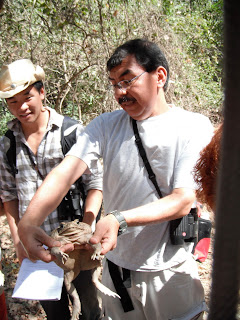
Mau holding a marine toad, which we encountered during our plant walk.
The next day we spent the morning walking around the park with our professors, learning about the plants that we saw. We have another plant test while we're at this site, so this was our first introduction to the new plant families we will be responsible for identifying later on in our stay here. 

This toad peed out (exploded would be a better word) about half of its body volume while I was holding it! Haha
In the afternoon, we had a lecture about ant/plant interactions. Acacia trees are common in Palo Verde, and you can see firsthand the acacia/ant mutualism that biology textbooks often reference when discussing symbioses.

An acacia tree with the ants that live on it. The plant provides a home (the hollow thorns) and food (nectar and protein-rich growths on the tips of leaflets) in return for the protection against herbivores that the ants provide. The ants are aggressive with biting mouthparts, and will attack anything that touches the tree they live on.
The marsh at Palo Verde, which is very close to the station where we're staying.
 After class I did some more research for my ethics presentation, which was about data manipulation and scientific misconduct in general. At 5 a few other students and I hiked up to a lookout point (mirador) behind the field station to watch the sunset, which was awesome! The sky here turns purple-ish around sunset, and from the lookout point you can see really far across the lowlands. We made it to dinner a little late because climbing down the sharp rocks took a lot longer than climbing up them did, but it was worth it. After spending some more time putting together the ethics presentation, I went to bed.

The view from the lookout point
The next morning, we drove to an agricultural region just outside of the park. While the dry forest is not normally a good place to grow crops because it's so dry in the dry season (duh), a dam was built about 30 years ago that redirects water from a river on the east side of the mountains down into the western valleys, providing water to the Guanacaste region of Costa Rica. Because the soil is relatively fertile, adding water allowed people to begin growing high-input crops like rice, sugarcane, and melons. We talked to a farmer and got to see a large rice field and a sugarcane field, although the cane had just been harvested and the field burned, so there wasn't much to see there. The rice field was pretty cool to see, though, and I especially appreciated getting the opportunity to talk to the farmer who owned the land and learning a little bit about how and why he became a rice farmer, where he gets his seeds, how he manages his land, and what happens with the rice that he harvests. Interestingly, banks will only give loans to farmers who use them to buy seeds from certain companies, so the banks essentially control the types of rice that gets planted. The types of rice that get planted furthermore determines the type of input needed to grow it. The seed companies that farmers are allowed to buy from are genetically modified to resist the herbicides that the farmers use to kill weeds, and the seeds themselves come with certain agrochemicals that the farmers then need to put into the system in order to obtain maximum yields. I'm not against genetically modified crops or non-organic agriculture in principle, but I do think it's interesting when farmers get more or less financially cornered into growing food a certain way.


A rice field flooded with water just outside of Palo Verde.
After our afternoon classes, we put the finishing touches on our ethics presentation, while people who weren't presenting had free time. We gave our presentation and led the discussion after dinner, which went relatively well. We focused on three factors that we believe can cause scientific misconduct: funding, career pressure, and advocacy. It was interesting to hear people's perspectives about how all of this relates to our potential futures, and how you can benefit personal needs (e.g. salary, career advancement, and personal beliefs and values) with scientific ethics.

We had a free day the next day, and didn't need to go to sleep as early as we normally would, so some of us decided to take a walk around the marsh at night. We saw some cool wildlife, including crocodile eyes (you can see them reflecting back at you at night, even when you can't see their bodies!), some amphibians, and a snake!

One of the frogs we saw
A snake! Not venomous, to the best of our knowledge.
After returning from the marsh, I played a round of poker with a group of classmates before going to bed around midnight. (So late! Haha.) Even though we had a rest day the next day, we have our first independent projects at Palo Verde, so I wanted to have a productive day of exploring the park and beginning to think about project ideas.

Friday, February 11, 2011

Las Cruces, pt. 8: Don Roberto

Our first day back from Las Alturas, we spent the morning visiting Don Roberto, a farmer that lives about 20 minutes away from Las Cruces. We went in two groups so that we could get a more intimate experience at the farm, and split based on Spanish ability so that our professors wouldn't have to translate everything twice. I was on the fence about which group to go in, but the advanced Spanish group had fewer people signed up for it, so I decided to go with them to try to even out the numbers. So, when we toured Don Roberto's farm, our whole talk was entirely in Spanish. I was a little nervous that I would be totally clueless since my Spanish is still rusty, but I think I understood about 80% of everything he said, so I was pleased in the end. 

Don Roberto owns a small farm, but grows a variety of crops. When we first arrived, he demonstrated how to extract the juice from sugarcane, which you can drink straight or ferment into cacique, a sweet liquor that is common in Costa Rica. We got to try the cane juice, but most of us thought it was a little too sweet to drink as is. According to Don Roberto's wife, he drinks about 4 liters of cane juice a day when he is working in the fields. Since it is basically just sugar water, I'm sure it keeps you energized!

Don Roberto (right) extracting juice from sugarcane, with his wife straining it and catching it in a pot.
Don Roberto also grows a good deal of coffee, and showed us every step in raising, harvesting, and preparing it. It was pretty cool to see in person, especially since we had been learning about coffee in our classes.


Don Roberto showing us the different size coffee seedlings.
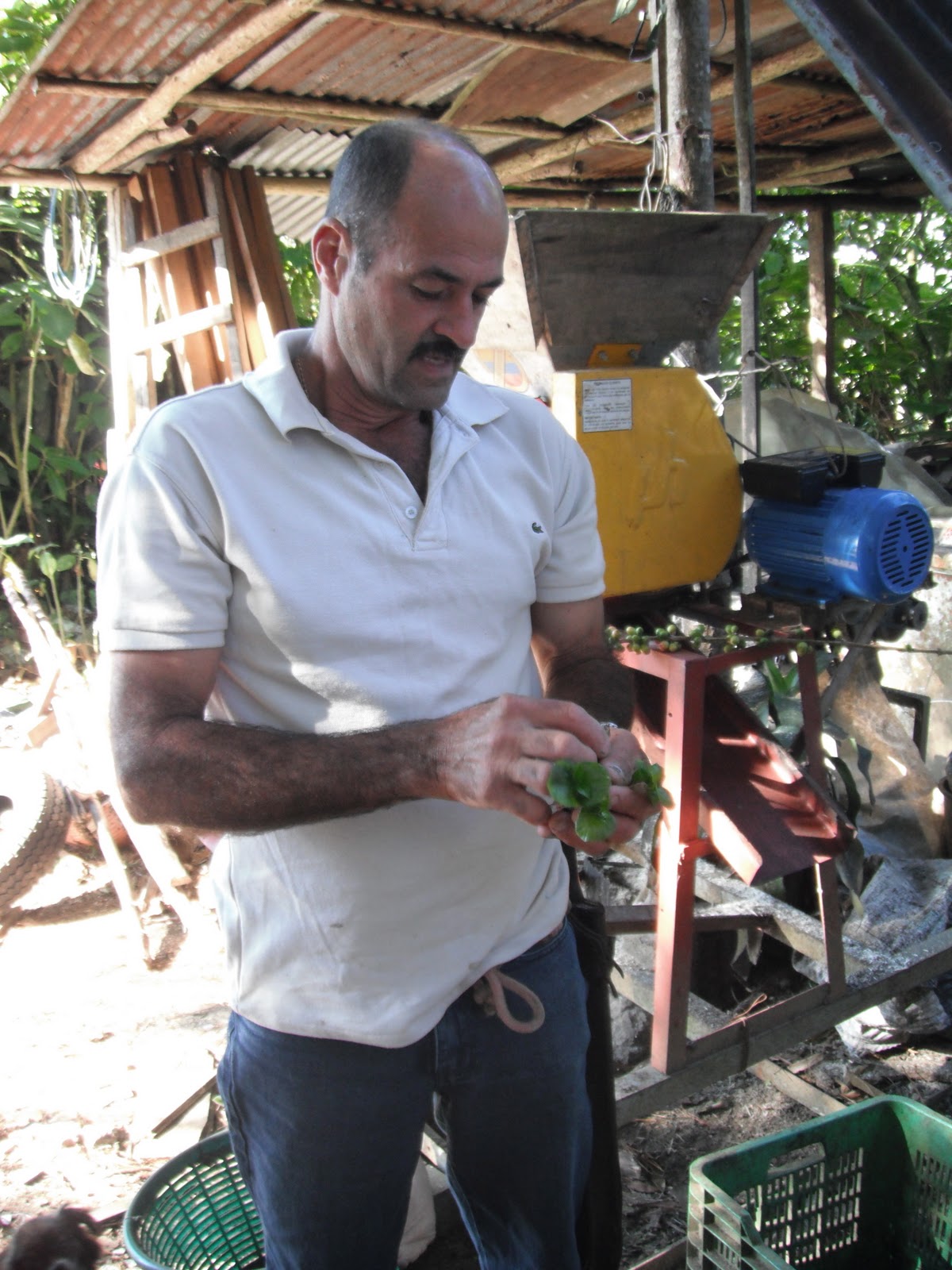
Separating coffee beans from the skin surrounding them.
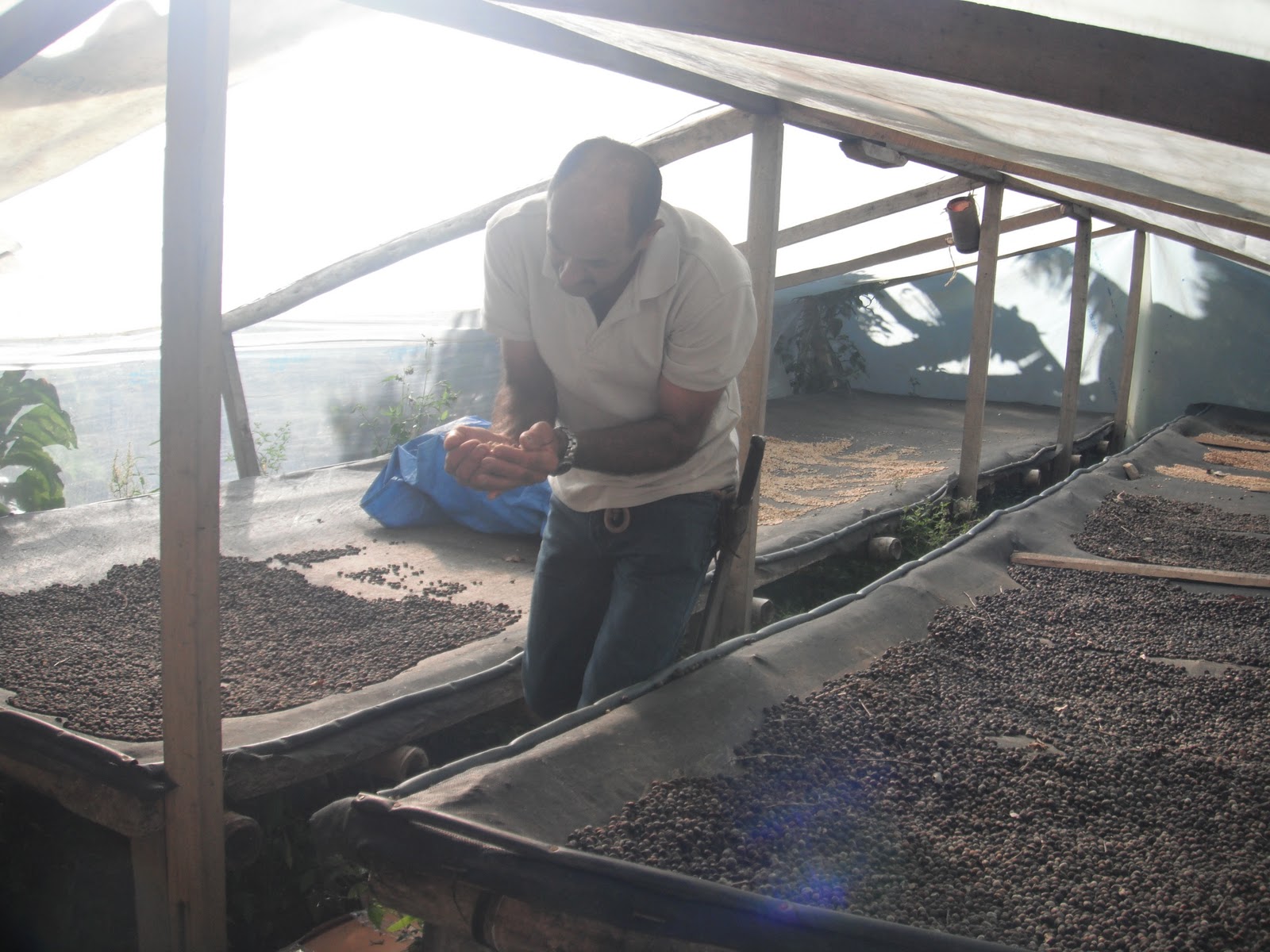
Coffee beans drying in the sun.

At the bottom of his plot of land, Don Roberto keeps some forest. While he is not receiving Environmental Services Payments (which we have also been learning about in classes), he preserves forest on his farm voluntarily. He talked a lot about how his involvement with a co-op changed his perspective on farming (he now uses minimal pesticides and herbicides, and composts to cut down fertilizer needs) as well as conservation in general. He used to use the forested land to graze cattle, but about 18 years ago decided to let the area regenerate naturally. Now it is a nice patch of secondary forest, which helps protect the watershed and provide habitat for animals. It was really interesting to hear how his perspective had changed over time and how important he felt that maintaining a balanced and well-informed personal mindset is on allowing people to both make a living and be environmentally conscious.


A field of beans

Las Alturas!

Saturday morning we set out for a weekend excursion to Las Alturas. Las Alturas is a large private farm owned by an American businessman who apparently is interested in conservation and hobby farming. He bought the land from a logging company, which had bought it from a French national who had originally received the land from the Costa Rican government in the early 1900s. When the logging company was in control, they deforested about 1/3 of the property, but upon the most recent purchase of the land, logging stopped entirely. The current owner preserves the remaining 2/3 of primary forest on the northern part of the 10,000-hectare parcel. We set out early Saturday for a long drive, only the first 30 minutes of which was on paved roads.

Carlos, our wonderful driver, while driving through San Vito.
In transit.
Carlos in the rear-view mirror while we stopped to look at a forest edge on the way to Las Alturas.
Daniel, our TA, during the pit stop.
We made it! Yes, their logo really is a yin yang sun rising over green mountains.

When we finally arrived at the station, Zak, the director, realized that he had forgotten one of the keys! Most of us settled into our rooms and made the beds, but twelve people were locked out until someone from Las Cruces finished the journey out to bring the missing key. The station was rustic, with no hot water and no electricity, but everyone was excited to try something new after being spoiled at Las Cruces for so long.

The biological station, where we stayed.
We didn't have anything planned until after lunchtime, so a bunch of us played ultimate frisbee or soccer in our free time. Frisbee was fun, but the yard was uneven, and surrounded by barbed wire to keep out the cattle. This made chasing long passes extra exciting! No one got hurt, which was excellent. Then we ate lunch and got ready to go into the town.


Daniel and Ethan playing soccer.
Compas munchin' on lunch.
We were all excited to be there, except apparently Stephanie.
Cattle grazing behind the station.


When we got into town, we got to learn about how Las Alturas functions. The owner
 hires 49 families to work and live on the farm. They grow enough vegetables, chicken, and cattle to be relatively self-sufficient, and, since the owner is already wealthy, don't even sell their products. They also have a tree farm, where they collect seeds of native species from the primary forest, cultivate them, and then replant parts of the farm that they are attempting to reforest.


The elementary school and a soccer field in the community.

Lots of the houses are painted bright colors!
The river running through the community, which powers the saw mill.
This is the only store in town.
A chicken coop near the tree farm.
Coffee beans drying.
Achote, a red spice that can also be used as a pigment! We tried it in fruit lab.
The tree farmer amongst the seedlings he grew. He's been doing this for over 20 years.
Learning about tree growing from the farmer.
Another resident of Las Alturas, watching us get our lecture at the farm.
Daniel and Carlos playing with one of the many dogs of Las Alturas.
Baby trees!
An ox-powered mill where they extract the juice from sugarcane.
New friends peeking out of their houses.
ADORABLE!
Some of the group, with mountains in the background.
Cine las Alturas, the town movie theater, which plays one film a week.
The town even has a small jail to throw people in for drunkenness.
More colorful houses.
Farm equipment
Little kids playing soccer near the general store
Ashur and Tom admiring the owner's pond.
Tessa, Steph, Ashley, and Carolyn sitting outside of the owner's house.
Manny looking fly in our professor Mau's head scarf.
A bird of paradise flower.
Random caterpillar someone found on a leaf.
Zak, the director of Las Cruces, telling us about the vegetable farm.
Where they grow all of the vegetables for 49 families.
A tiny choyote, which we tried in fruit lab and is one of Chesca's favorite foods.
The vegetable farm, with fruit trees and nitrogen-fixing clover interplanted.
A banana tree.
A bunch of bananas, as seen from the bottom.
Leaving the veggie farm.
Rukhshana in the car on the way back to the station.
The sunset, as seen from my bunk bed in the station.

After an awesome day in the town, we headed back to the station for dinner and a lecture. At 8 pm we had a bonfire, singing songs and telling stories for a few hours until we all got tired. The next morning we woke up early and started a hike at 7:30 am. Arguably the coolest thing about Las Alturas is that it shares a border with La Amistad International Biosphere Reserve, which is 500,000 hectares of completely protected primary forest. We hiked a 2.5 km trail into the forest and gained 600 m in elevation, making it our most intense hike yet. As we hiked into the undisturbed forest, we could hear monkeys calling for a good portion of the hike, and about an hour and a half in we actually saw some! It was really awesome. Unfortunately no one got pictures because they were so high up in the canopy and moving so quickly. 
As we moved up in elevation, we also got to see a cool change in the plant life. We moved from a normal rainforest into a bamboo forest, and, at the highest elevations, an "elfin" forest where all of the trees are stunted. My camera was almost dead and I wanted to save battery for when we got to the top, so I didn't get too many pictures from the hike, but I can assure you that it was really cool. We also met a German researcher studying jaguars there, and he came on the hike with us so I got to know him a little bit throughout the morning, which was cool.

Passing through the bamboo forest was awesome.
The view from the top. It was definitely worth it.
Not the greatest picture, but proof that I made it!
After we hiked back to the station, we showered, had lunch, and cleaned up the station so that we could  head back to Las Cruces. Most people were on a bus that we had rented for the weekend trip, but I was in the OTS truck with five other people. Daniel was with us instead of the professors, so he let us stop at a field of sugarcane and cut some down for us to snack on with our machete.  

Nate holding some sugarcane.

When we finally got back to Las Cruces, everyone was reluctant to go back to normal classes after having our first experience at a more isolated site. It was an awesome trip, though, and definitely got everyone looking forward to Cuerici, our next destination, since we only had a few more days left at Las Cruces.