Showing posts with label Palo Verde. Show all posts

Monday, April 4, 2011

Palo Verde, pt. 6: Wrapping up

Our midterm exams were on Monday 3/7, so Sunday we had a day with no activities scheduled so that we could study. I had a relaxing day reviewing my notes and napping, since I had sustained a serious sunburn on my back and legs at the mangrove beach (they didn't tell us we were going to a beach, so I didn't have sunscreen!) and was dehydrated and tired. Luckily my generous friends applied aloe to me every now and then in return for my lending them anti-itch cream for bugbites and Neosporin for mysterious rashes... after three weeks of constantly sweating in Palo Verde, almost everyone had some sort of weird ailment. The next morning, we had our environmental studies exam, which covered all of the topics related to Costa Rican environmental policy, management, politics and economics that we had studied so far in the semester. The exam was three hours long, but most of us finished early and used the remaining time to study a bit more for our next test. In the afternoon we had the biology exam, which covered everything else from the first half of the semester. Luckily neither exam was too difficult, since the material we were responsible for knowing was very extensive. Overall I thoght they were both fair tests that we were prepared for.

All of our other final assignments were due the next day at noon, so after the exam Rukhshana and I walked down to the river to do our field notebook assignments. After our 30 minutes of observation and description were done, we hung out and watched the sun set, which was (as usual at Palo Verde) beautiful.


We came back for dinner, and then got to work on our other remaining assignments: insect identification and a plant taxonomy practical. I did all ten insects in one night, and it took me way less time than the insect IDs at Las Cruces, which I was very pleased about. Then I did our plant practical, which was creating a dichotomous key that could be used to identify ten plant species found at Palo Verde. After spending some time hanging out and chatting with my roommates (a very frequent occurrance for us), I went to bed feeling very productive since I had completed two exams and three assignments all in one day.

After lunch on Tuesday we received back the rough drafts of our IP writeups, and had one day to redo them. In the rough draft I had gotten all of the ideas down that I wanted, but still had to read a lot more literature that I didn't have time to get through while we were doing data collection and analysis. I spent the rest of the afternoon and the next morning reading and taking notes on about 20 additional papers, and then reworked my paper Wednesday afternoon. The final copies were technically due at 5 pm, but most people hadn't finished and our professors were pretty flexible about all things related to the IPs since we were so short on time. I had finished writing mine by dinner time, but then took a break to eat and proofread it after dinner. Since it was our last night in Palo Verde and also since the station was full of OTS directors for a meeting the next day, the kitchen staff slaughtered one of the cattle for us and had a giant barbecue complete with fresh meat, patacones (fried plantains), rice and beans, and, the unanimous favorite, (LOTS of) guacamole. It was a serious feast and felt like a celebration of all of the hard work we had been doing at Palo Verde. After dinner, the party continued; the next day was Tom's 21st birthday, but since we were spending most of the day on a bus and then dispersing to our homestays, we decided to celebrate the night before. Because the directors were staying in all of the buildings, we couldn't be loud there and went out to the pier to celebrate. We ran into another group of college students from the University of Florida who had been staying down the road from us for a week but we had never seen until that day. They were also leaving the next day and were celebrating their last night in Palo Verde, as well. The next morning, we all managed to wake up early, pack our stuff, and be on a bus by 8:30 am to head to San Jose, where we'd be spending the next two weeks.

Sunday, April 3, 2011

Palo Verde, pt. 5: A mangrove excursion

At 8 am on Friday, 3/4 we left Palo Verde for a trip to a mangrove forest! It took us several hours to get there, and then we hiked in through private property, ducking under barbed wire fences to cross some pastureland before arriving in the mangroves. It was amazing how quickly we transitioned from open fields to regular shrubs and trees on a forest edge to a full-on mangrove forest with almost exclusively mangroves growing there.

Mangroves are a paraphyletic group of trees that have all evolved adaptations to deal with high salt content in their water, poor nutrient availability in their soil, and occasional to frequent flooding caused by tidal changes. Mangroves live in coastal tropical and subtropical regions, in places where salt marshes would exist in temperate zones. The first type we encountered was the black mangrove, which is the least salt-tolerant species that we saw and thus lives farthest inland. The trees look relatively normal, except for the fact that they send up short above-ground roots called pneumatophores which help with gas exchange when the tide comes in and the area is flooded.

Pneumatophores covering the ground of the black mangrove forest
Also, they deal with high salt levels by excreting it on the bottoms of their leaves! They excrete so much salt that you can see the crystals on the bottom, and if you lick the leaves you can taste it. Tom described it as having the same amount of saltiness as a pretzel, which I would agree with.

Salty leaves of the black mangrove trees
After a brief introduction to the black mangroves, Mau gave us some time to sit in the forest and observe our surroundings. We then talked about the main differences we noticed between the mangrove forest and the other tropical forests we'd seen, and determined that the most striking one was the lack of biodiversity in the mangroves. They are literally the only plant species in sight, with no groundcover or subcanopy growth whatsoever. The only animals we saw were fiddler crabs, which burrow holes into the salty mud... none of the birds, lizards, frogs, or monkies that we'd been seeing at other sites.
One of the many crabs we saw
Aside from a few mosquitoes (which are apparently much more abundant in the wet season) and some termites, we didn't even see any insects! Also, the forest structure is much simpler with a relatively uniform canopy height and really no other layers of foliage.

Nothing but black mangroves, as far as the eye can see.
We kept walking towards the coast (over the pneumatophores, which make the mud feel bouncy when you step on them!) until we got to the red mangroves. Because they are more salt-tolerant, they live closer to the water, which means the mud there is REALLY wet! This was one of the first hikes that I felt like my rubber boots were truly necessary, and I was glad I had worn them. There were some places where you could unintentionally sink in up to your knee in mud, and that happened to a few people while we were entering the red mangrove zone. Red mangrove is the type of mangrove that you probably think of when you think about mangroves in general, because they have the very distinctive prop roots that are easy to remember.

Red mangroves
Hiking through a red mangrove forest is not an easy task, since on top of the mud you have to climb over, under, and around all of the crazy above-ground roots of the trees. When we had gotten far enough into the forest, we stopped for lunch, which we had packed in with us that morning. We were all hot and sweaty, but it was pretty neat to eat a sandwich while perched five feet above the ground on a giant tree root.
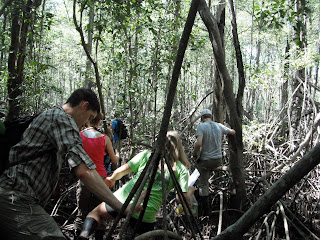
Hiking through the red mangroves felt like spy training in the movies when you have to cross a room secured with laser beams, you know?
After lunch we talked about the red mangroves a bit, and then split up into small groups to do an activity. Our professor had brought a lengthy review article about mangrove ecology, and split it up into sections so that each group could read a small part and then present it to the class. My section was about the importance of mangroves in the fishing industry, since many young fish hatchlings use mangrove forests as a sort of nursery, since the water is calm and protected and there is an abundance of food. After discussing the article, we all wrote down some short ideas about how to restore mangrove forests, since many of them have been destroyed worldwide for coastal development and flood management, and then started to head back because the tide was coming in! It started while we were presenting our article sections, and happened really fast. Again, I was glad to have my rubber boots! We all trekked out through several inches of water, which made the mud even sloppier.

The tide coming in and flooding the forest!
At one point my foot sank in to below boot level, so my boot filled up with muddy water that splashed all over my pants when I tried to dump it out. By the time we made it back to the bus, I was basically completely soaked, but still in awe of the mangrove forests. It was an amazing ecosystem to see, and unlike anything I have ever experienced before, in Costa Rica or elsewhere. I changed into my extra pair of shorts on the bus, and we drove another hour and a half to get to the field station where we were spending the night.

We arrived at 5, and discovered that we were staying approximately 4 blocks away from a beach! Mau didn't tell us this in advance, so of course none of us had brought bathing suits or other beach-appropriate things. We were so excited to be at the beach (for the first time since we'd arrived in Costa Rica!) that we all went anyway, me in my hiking boots since I didn't even bring flip-flops for the one night trip.
First glimpse of the beach across the street from our station
Sunset!

Sunset + amigas!
We went swimming in our clothes right as the sun was setting, and swimming out about 100 feet in the calm cove we could actually see the sunset which you couldn't see from land. The water was warm, the sky was beautiful, and we were all incredibly happy. Going to the beach is almost always relaxing, but the stress of our independent projects and the surprise of not knowing we were going to the beach made our 30 minutes in the water that much more enjoyable.

We returned to the station for dinner as it was starting to get dark. I had only brought one extra pair of shorts since the trip was so short, which I had worn swimming, and my field pants were still soaked with muddy water from the mangroves. I was mentally readying myself to wear a bedsheet until my clothes dried the next day, but right before dinner Chesca lent me the shorts she had brought to sleep in. We were supposed to have a class that night, but our professors rescheduled it for the next morning so we had the evening free. Some people stayed up to have a fiesta, but after sitting around and talking for a bit I was completely exhausted and went to bed at 9 pm. I had been awake since 4:45 am the day before, working on IP things the whole time and then leaving straight for the mangroves without sleeping the night before. Going to bed that night felt amazing, and I slept for 10 glorious hours.

The next morning we had a lecture after breakfast on mangrove ecology with a visiting professor who had studied mangroves extensively. Much of the class was a review of the things we had seen the day before, but I enjoyed it because I found it all very interesting the first time. After class we had free time until lunch, so of course we went back to the beach. My pants were still not dry from the day before, so I had nothing to change into if I went swimming. I enjoyed the beach from dry land, though, and hung out in the sun for a few hours, heading back to shower before lunchtime.

Back to the beach in the AM!
Strollin'
Quite content to be at the beach
On the way back to Palo Verde, we stopped at "Megafauna Park," which is basically a tourist trap on the side of the road somewhere near the coast. You pay admission to walk around a trail with giant cement sculptures of large animals of Costa Rica, both alive and extinct. It was kind of a joke thrown in by Mau since we had spent so much time talking about gomphotheres, a group of extinct megafauna, in Palo Verde. We spent about two hours there looking at the poorly-made, disproportionate, and probably scientifically inaccurate sculptures, often times imitating their expressions ourselves since they all looked slightly crazed.
The T-rex that guards the entrance to Megafauna Park
Monkey face?

Tessa and an anteater
Patrick imitating some large animal that I don't recognize, and doing a fantastic job of it. Tyra would be proud!
This guy was FIERCE.

Patrick next to the giant ground sloth, which was grossly disproportionate!
Another crazed-looking cement statue
There was also a small insect museum attached to the gift shop, which was interesting because the insects were arranged in interesting patterns and hung like pieces of art.

Insect art

After our jaunt with the poorly-recreated megafauna, we finished our bus ride back to Palo Verde, arriving just in time for dinner.

Palo Verde, pt. 4: Independent projects

At the beginning of FLP week, I still had no solid idea to work with for the upcoming independent project. I knew that I was vaguely curious about trade-offs in anti-herbivore defenses in acacia trees, wondering if species with obligate ant interactions produced lower concentrations of secondary compounds than species with facultative ant interactions. However, I had talked to my professor Erika about this idea and she told me that because there are only about 4 species of acacia at Palo Verde, I wouldn't be able to gather enough data to make generalized conclusions about the potential trade-offs between biotic and chemical defenses in plants. I was also interested in the agroecosystem in and surrounding the rice fields that we had visited earlier for class, but didn't at first see any connection between these two ideas. However, at some point during the week it clicked for me, and I decided that I wanted to study anti-herbivore defenses in non-agricultural plants near the rice fields, predicting that they would have decreased defenses because of agrochemical use lowering the herbivore pressure in the region. Once I had my idea formulated, I talked to my professors about it and they gave it the OK. Rukhshana and Owen also decided to work with me, so by Thursday we had a team, a question, and a plan of attack.
Rice fields near Palo Verde where we did our IP
Wastewater flowing out from the flooded fields
The wastewater, contaminated with pesticides, flows out from the fields in exit canals like this one. The big trees on either side of the canal are guazumas.
 After our FLP presentations on Thursday morning, a bunch of students including me, Rukhshana, and Owen took a ride back out to the rice fields to make preliminary observations for the IPs. Most people were still looking for a question to work with, but we were out scouting for plants with quantifiable anti-herbivore defenses that grow abundently near the rice fields. We took about 20 samples and brought them back to Palo Verde, where the three of us met with our professor Susan. Our original plan was to compare plants near the rice fields to plants at Palo Verde, so Susan helped us sort through and identify our samples, pointing out the plants that plants that we might also find in the park. Unfortunately most of the abundant non-agricultural plants in the rice fields are weeds that don't  grow much in Palo Verde, so we had limited options to work with. However, we did notice some familiar faces growing along the edges of the irrigation canals in the fields: Guazuma ulmifolia, a large tree with trichomes on its leaves, and Vachellia collinsii, an acacia species that depends on agressive ants to protect itself against herbivores. Trichomes are like little tufts of hair on leaves that help prevent dessication and also discourage insect herbivory by making the leaf fuzzy and difficult to bite. Because they are discrete, they can easily be quantified just by counting their density using a dissecting microscope with a grid. The acacia trees use extrafloral nectaries (EFNs) to encourage ant inhabitation, so counting EFNs and measuring their size is a way to quantify the trees' defenses.


Guazuma trichomes, as seen through a dissecting microscope.
Vachellia extrafloral nectaries (EFNs)
To make our experimental design more robust, we wanted to find a third plant species to examine, and do some sort of additional analysis of chemical defenses on all three species. Unfortunately, one thing that OTS sorely lacks (in my opinion) is good lab space and equipment at the field sites, so most of the chemistry protocols we encountered for quantifying anti-herbivory chemicals in leaf tissue were way too advanced for our situation... The most serious equipment we had were mortars and pestles, and the most heavy-duty chemicals we could get our hands on were acetone, ethanol, vinegar, and  water (tap or bottled, but neither deionized or sterile). Needless to say, we were feeling pretty limited. When it came time to present our proposal on Friday morning, we still had not worked out the details of the third plant species or the second test we'd be using.

Regardless, we started to work. Data collection officially started on Saturday, but we spent the afternoon walking around Palo Verde and looking for forest edges facing the same direction as the irrigation canals in the rice fields. Because trichomes on leaves also help prevent water loss, it was important that our control site plants be getting approximately the same exposure as our plants at the fields. While we were flagging usable trees with fluorescent tape, something amazing happened: it rained! In the dry season! And when I say rained, I mean it POURED. After having been at Palo Verde for over a week already and sweating almost constantly, everyone was ecstatic. We all ran back to the building, dropped what we were doing, and sat in the rain, ecstatic. It felt amazing, and was a welcome last bit of freedom before the true work of IPs began the next morning.

Enjoying the rain on a hot and muggy day

Like I said, it was pouring!!! Miguel said that this is what the rainy season is like every day. I can't even imagine!
At dinner, we talked again with Susan, who told us that we should find a new control site closer to the rice fields to use in our experiment. Because Palo Verde is about 30 minutes away by car and is also partially wetlands, the soil types between the rice fields and the park are very different, and our professors thought it would be better to try to eliminate that as a potential confounding factor. So, the next morning when we began collecting samples, we went to a new site northeast (upstream of wastewater exit canals) of the rice fields and got 21 samples of vachellia. We needed 30 samples at each site with three individual leaves per sample, and getting just 21 took all morning because of the ants. As it turns out, vachellia's biotic defenses are pretty effective against herbivory, and all other sorts of threats. As soon as you touch a leaf to snip it off and take a sample, the ants come running down the stem and attack, biting all over your hands (or wherever else they land). We had to be really careful, and even so we still got eaten alive, literally. We came back for lunch and went back into the fields at 1:30, getting our 30 samples from the rice fields and our 9 remaining control samples. After dinner Rukhshana, Owen and I spent lots of hours up in the lab building counting and measuring the extrafloral nectaries on all 180 vachellia leaves, and then enetering our data into a spreadsheet. We also had decided on an herbivore preference test for chemical defenses, which our professors recommended because of the relative ease of the protocol. The general idea is to make a crude leaf extract and present it to ants, and see how much the ants eat compared to a sugar-water control. So, on night 1, we also made an ethanol-based extract from vachellia leaves from both sites. By the end of the first day, we were already exhausted!

The next morning, Owen and I went back out into the field to collect our guazuma samples. Rukhshana stayed behind to do our ant bioassays for the vachellia leaf extracts, which we had to repeat on 20 different ant colonies of the same species. Because another student needed to be driven to a different off-campus site to gather data, the driver couldn't stay with us all morning like he had the day before, and dropped us off at the control site. We collected 30 samples from our control site, and then started to walk to the rice fields since we weren't getting picked up until later that afternoon.

Owen climbing a tree to get a guazuma leaf sample
Unfortunately there are a LOT of rice fields near Palo Verde, and they all look really similar, so we got lost and were wandering around the roads for THREE HOURS, all while carrying around a garbage bag full of leaf samples and an 8-foot long pole pruner for clipping high-up branches. We realized in retrospect that we had walked all the way around the entire region because we missed a turn down the road that took us to the fields we were working at, and by the time we found our way back to the right place by walking back to Palo Verde and going back out from there, the driver was already waiting to bring us back. He doesn't speak any English and we were too hot and exhausted to explain what had happened in Spanish, so since we weren't sure whether or not someone else needed to be driven somewhere in the afternoon, we went back to Palo Verde with zero of the 30 samples we needed from the fields. After a bit of rest and SHADE (which does not exist in rice fields), we went back out for two more hours and collected all 30 of the samples we needed. I took the most glorious shower of my life when we had finished our hot and exhausting field work for the day, and ate a very satisfying dinner. Then I spent several hours counting the trichome density on some of the guazuma leaves, since lack of microscopes and issues of inter-observer reliabilty prevented us from sharing the work among all three of us. While I was counting, Rukhshana and Owen made the leaf extracts for the guazuma samples. Because I was so exhausted from our crazy day, I only got through about 1/4 of the leaves that I needed to look at, but I decided to just go to bed and finish it the next morning.

After getting some rest, I spent the entire next day counting trichomes at the microscope. Rukhshana completed all of the ant bioassays that we needed for the leaf extracts, and Owen went back out into the field with Susan to try to find a third species that we could use. Miraculously they were able to find one that grew at both sites, a shrub with trichomes called Malvaviscus arboreus, and collect the 30 samples from each one all in one day. I finished counting trichomes around 8:30 pm (seriously!), and handed off the trichome-counting responsibility to Owen for our malvaviscus samples. While he was working, Rukhshana made leaf extracts and I assembled a datasheet for our grazuma trichome information. We were all tired again, and Owen and I had gotten sunburn while lost the day before, so we went to bed at 9 pm, which felt wonderful.

Rukhshana observing ant responses to extracts made from leaves near the rice fields, far from the rice fields, and a sugar control.
By counting the number of ants present on each petri dish after a certain amount of time and dividing by the number at the sugar control, we could determine the relative palatability of the leaf extracts. A leaf extract that is less palatable to herbivores presumably contains more chemical defenses against herbivory.
Tuesday was our last day of data collection for the IP! Owen counted trichomes all day, literally from about 8 in the morning until about 1 am the next morning. Rukhshana and I did the remaining ant assays, and I started analyzing whatever datasets were complete. We met with Susan, and realized that we had significant results! She was very excited for us (as were we!), and it was amazing to comprehend that we had actually accomplished something both interesting and kind of important in just four days. The next day was dedicated to finishing our analyses and putting together our results, whichw e had to present on Thursday. We met with Susan several times to create our Powerpoint and interpret our results. The next morning was spent rehearsing our presetation, which we gave that afternoon. As soon as the presentations were done (which were really neat to listen to, since everyone had done completely different projects), we had a little bit of time to break down everything from our experiments, i.e. washing some glassware and un-flagging the 20 ant colonies we had used for bioassays. After dinner, I started writing my lab report rough draft, which was due the next day! I stayed up all night and it took me until 6:15 the next morning, but I finally finished, just in time for the first break we had had in a long time.

Palo Verde, pt. 3: Faculty-led projects

Tuesday 2/22 through Thursday 2/24, we worked on faculty-led projects with Jordan, a professor from Tulane, and Ignacio, a graduate student at the University of Costa Rica. On Tuesday and Wednesday we did data collection, splitting up into two groups and working on one of the two projects each day. I worked on Ignacio's project first, and collected data on Green Lynx Spiders all day. We were testing to see whether spiders gain experience with age by looking for relationships between spider age (juvenile/adult) and responses when encountered with a predator.


A green lynx spider (Peucetia viridans)
Ruellia inundata, the plant where green lynx spiders live. Rather than building webs, they perch on the plants, wait for pollinators to pass by, and then pounce on them.
We did this by simulating predation with a false bird beak (aka a stick sharpened to a point and wrapped in black electrical tape) and measuring how close we could get to the spider before eliciting a response, the response distance, response type (run, jump, shift, etc.), and response location (leaf, stem, flower, or ground). 

A "simulated predation event." Chelsea is moving the stick, or model bird beak, towards the spider, and Carolyn is waiting to measure and record its response distance and type.Photo by my professor, Mau.
While 14 of us were gathering data all day, a smaller group of six was responsible for compiling all the data, writing it up, and presenting it to the class. I was in the small group for Ignacio's project, so after a long morning of finding, poking, and observing 50 or so spiders, I spent the afternoon making a giant dataset of all of our observations from day one.

On Wednesday, the other group was collecting spider data with Ignacio, and my half of the class went with Jordan to work on his project. He was observing bird behavior based on population density to see if behaviors that decrease vigilance toward predators (e.g. foraging) is more prevalent in areas of higher bird density, overall looking at the osts and benefits of social behavior in birds. We spent the day observing Northern Jacanas at three different sites in Palo Verde, focusing on one individual at a time for five minutes of observation. We worked in pairs so that one person could record the behaviors that the person with binoculars observed; however, I was working with Rukhshana, and she got sick that morning, so I ended up working in a group of three with Ashur and Inca.


A really terrible picture of Jacana spinosa, the Northern Jacana. If you look closely you can see one on the right hand side about half way down. Everything else in the picture is water hyacinth in the marsh. Northern Jacanas are actually really cool looking, and Google images can probably show you much better stuff than this!
Birdwatching in the marsh at one of our lookout points
Justin simulating the Jacana's aggressive wing-display behavior on Matt.
The big croc!
Because both small groups had to present on the research the next day, we only gathered data in the morning so we could work on analyzing the data later in the day. Although we were only out for about five hours, it was an exciting morning. First, Inca got chased by a herd of cattle that live out in the marsh to keep the invasive grasses under control, which was scary! Then, at our last observation site, we saw some crocodiles out in the marsh from the bird observation tower, which was really cool. We found a small one at first but then went back down onto the ground to tell other people, and Ashley came over and spotted one that was at least 6-8 feet long off in the distance. We watched it for a while as it swam around in the marsh and over to a flock of whistling ducks, which we thought it might try to attack. Unfortunately we didn't get to see the crocodile eat anything, but it was awesome to watch nonetheless.

After lunch,  I spent the afternoon compiling the second day's spider data and running statistical tests on the complete dataset. I gained a lot of respect for professors like Bob Kaplan at Reed, who have to piece together huge datasets for class-wide ecology experiments... it's hard work! You have to be very careful to try to notice errors in data input by all of the contributors, figure out what they did wrong, and fix it, as well as making sure everyone's data is consistent in units and format. It took me a few hours just to get everyone's data into a usable form to run statistical tests, since for some of the observational components (e.g. response type) people had recorded a lot of things that were not in our list of options or were entered differently. When the dataset was complete, I spent the rest of the afternoon analyzing it with eight different tests. Then after dinner my group of six met to discuss and interpret our results, exchange notes on some literature we had read, and put together our presentation to give the next day. It took a long time to get everything together, but we finished up our presentation by midnight (which is very late for us!). In the end we found that adult spiders had significantly lower predator distances at the time of response than juvenile spiders, and that while some adult spiders had no response whatsoever (they stayed still even when the "predator" was at a distance of 0), juvenile spiders always responded in some way. These suggest that the adult spiders may be better able to identify our "predators" as a non-threat, since they were not entirely realistic replicas of bird beaks and since they were approaching the spider very slowly. This would support the experience hypothesis, that older, more experienced spiders can more accurately evaluate the costs and benefits of fleeing from a predator and losing their perch on the plant, which they require to catch their food (pollinators like honey bees). Our presentation the next morning went relatlively smoothly, and I was impressed that we could actually gather enough data in a day and a half to get interesting results. Prior to the FLPs I had been pretty skeptical of the OTS independent projects, in which we only have four days to gather data; the shortest IP I've ever done at Reed has been about six weeks, and all of them have felt like I could have used more time if it were available. However, after seeing how much we could pull together in just two days, I was feeling more optimistic about our IPs, which were our next big task at Palo Verde. 


An unrelated picture of Palo Verde as seen from the dining hall, just because I want to post it. Haha.

Palo Verde, pt. 2: Rest day

Although we had just arrived in Palo Verde and hadn't been too busy yet, it had been ten days since our last rest day, so we had a day off on 2/20. Even though we could do whatever we wanted, I ended up waking up early out of habit, and decided to do some hiking anyway. I did a nice trail with Patrick and Maggie that started off about 30 minutes from our building. On the way to the trail, you walk through a mango grove where lots of white-faced monkeys always hang out! We saw a whole troop of them on the way out, which was a cool way to start off the day.

Just a few of the white-faced capuchins that we saw.
We chose to do this trail because Mau, our professor, had said that he likes it the best as an example of what the dry forest is really like. Most of Central American dry forests are now gone, but out on our trail we got to see a good diversity of plants (even some with leaves, which is rare in the dry season!), including cuatis, geckos, and iguanas.

An iguana, or ctenosaur, that we saw on our hike. They live all over Palo Verde and could often be heard walking on the tin roof above the classroom during lectures.
We saw deer poop, evidence that they're around although we didn't see them in person. And, most amazingly, we saw two howler monkies! You can hear them all over the place at Palo Verde, but we had never seen one before then. They are much bigger than white-faced monkies, and make loud grunting noises that sound like a cross between dog barking and hog squealing. In the opinion of Lee, one of my classmates, they sound like a human being beaten to death slowly. I disagree, but regardless, they have very loud and distinctive calls, and now we were able to see and hear them up close.

A howler monkey, up close and personal!

We stopped for about 30 minutes to watch the holwers and talk to an old Belgian man who was visiting and also monkey-watching. We then moved on to finish the hike, eventually arriving at a beautiful lookout point with a view of the marshland, the highlands in the distance, and the Tempisque River. It was about 11 am and it was hot (as usual!), but it was great to see the park from a different perspecive. The lookout point was rocky and warm, with lots of cacti around. After relaxing there for about a half hour, we headed back towards our bunks so that we'd be back in time for lunch.

The view from the top of the first trail we hiked. The little bit of reflected light in the background is the Tempisque River.
Patrick and Maggie resting at the top after our hike.
Returning to the dining hall at Palo Verde.
In the afternoon, I relaxed since I had had an active morning. I wrote a bunch of blog posts (the ones about Cuerici and Palo Verde!) and hung out on the porch of our building, chatting and taking my time. Around 4 pm, I left with Tessa, Lee, and Stephanie to look for the watering hole, which our professors had said was a good place to see wildlife at dawn and dusk. It sounded like it was easy to get to, but we weren't sure we had found it because it was a man-made pool, and we were expecting a small natural lake or something of the sort. We did see lots of acacia trees, which I accidentlaly fell against when I slipped off the edge of the pool, so I got lots of pricks on my right leg. I didn't get attacked by the ants that live there, though, so I was lucky. We didn't see any animals other than insects (mostly Africanized killer bees and mosquitoes) at the watering hole, so we left pretty quickly and decided to hike up to another lookout point nearby to watch the sunset. This one was called "La Roca," because the lookout point is just  a rocky outcrop at the top of a hill.

We made it to La Roca! ...Almost. We still needed to climb up the rocks in the background.
The hike is easy most of the way, but when you get to the top you have to climb up the rocks to reach the summit. The rocks were kind of sharp, but when we got to the top the view was well worth the scramble up. Since it was my third Palo Verde lookout point in two days, I could confidently say that it was the best view of the park, and being there at sunset made it even better. When Tessa, Lee, Stephanie and I arrived, Ethan and Matt were aleady there, and all six of us sat up on the top talking and enjoying the view.


After a while, Ethan and Matt left to go for a run, and Carmen and Ashur came up after also finding and leaving the watering hole. We sat there until the sun had set completely, and got to see all of the different beautiful views as day changed to night.

Tessa enjoying the view
Carmen looking sun-shiney
Hanging out at the lookout
Probably the best view of Palo Verde.
After the sun had gone down, we walked back to the station with our headlamps and had dinner. After a leisurely night of hanging out on our porch and listening to music, I went to bed relaxed and ready to do some work, since life at Palo Verde was about to get very busy. We had the next morning free to brainstorm ideas for our independent research projects, which we would be starting four days later. I didn't have any strong ideas yet, so it was basically another half of a rest day for me. After lunch we had some more lectures, one on gomphothere-disperesed fruits with Mau and two from the visiting researchers that we would be doing our faculty-led projects with in the next few days.