Showing posts with label San Jose. Show all posts

Monday, April 4, 2011

San Jose, pt. 4: Last days at CRLA

I returned to my homestay from Dota around 5 pm, and Maria was already cooking dinner. I was looking forward to spending our last week in the city, but little did I know that there was a little bit of 
the outdoors waiting for me at home! After putting down my backpack I sat down on my bed to see if the internet would work, and noticed that there was a little worm on my comforter. I picked it up and threw it in the garbage, thinking nothing of it, and went about my business. About fifteen minutes later, I noticed that there was another one up near my pillow. Curious, I moved my pillow and turned down my blanket, only to find dozens more of the little bugs! I didn't know what they were or why they were in my bed, but I knew that I needed to change my bedding, since they had been crawling around and leaving little trails of poop all over my sheets. Because my host mom is so generous and takes such good care of me all the time, I always feel like a burden asking her for anything. Hesitant to inform her that her house, which she takes great care to keep spotlessly clean (she even hires a cleaning lady to visit at least twice a week!), was infested with little grubs, I knocked on Mary's door instead. When she saw my room, she decided that we needed to tell Maria immediately, even though we both knew she would feel badly about it. So we told her in the best Spanish that we could muster what was going on, and she stopped cooking dinner to come investigate. Of course, she was mortified and confused about having bugs in the house at all, let alone in her guest's bed. We collected all of the bugs we could find, threw them out, swept the floor, and changed all of the bedding. I felt bad about making her do extra work (especially since she had just changed and washed my bedding three days before), but it was a relief to be able to go to bed that night in a clean and insect-free bed. The next day when I had internet access at school, I looked up some different pictures online and figured out that the mystery bugs had been housefly larvae. Luckily this made sense, because we had seen a single fly in my room about a week before the infestation, and although we killed it, it may have laid eggs somewhere in the house before it died. My best guess is that the eggs had hatched sometime around Thursday, and that while I was away for the weekend they were crawling up into my cool, dry covers to pupate. Of course the situation ended up being a hands-on biology lesson for everyone, which seemed fitting for my semester in Costa Rica. Bugs don't really bother me, so instead of being grossed out by the whole incident I found it kind of amusing, especially since it was so easily taken care of. Plus it made a great story to tell my biology professors when we returned from spring break!

Luckily, the rest of my time in San Jose was entirely bug-free. Our last week at CRLA was really packed with work, since we had an essay, a 20-minute presentation, and our three-hour final exam all in the course of four days. We essentially finished all of the grammar that we were learning by Tuesday, and spent the rest of our week doing less "academic" work and more casual conversation. Rebeca even took us out to get ice cream one afternoon! The same day I also went to a cooking class and learned how to make empenadas, which was lots of fun. 

Francesca cooking spicy ground beef to put in the empenadas. Can you tell that she is her happiest around food? Haha.
Empenadas frying... they were delicious! I definitely hope to make these back in the U.S.
I saved my empenada for later, since Wednesday is half-price movie day at the theater in San Pedro and Mary and I told Maria that we wouldn't be home for dinner. This week we saw Hall Pass (aka Pase Libre), which was awful! Thank goodness the movies are so cheap in Costa Rica, otherwise I would have been annoyed about spending so much money to see such a terrible film. A bunch of other OTS students saw it, too, and we at least all commiserated at the end about what a waste of time it was.

Thursday 3/24 was our last real day of class, and we spent all morning taking our final exam, which consisted of grammar, reading, writing, listening, and speaking. It was a very thorough but fair test, and it was nice to feel like I could take a test like that after only two weeks of Spanish classes. The amount which everyone learned in such a short amount of time was astounding. We had a short "graduation" ceremony before lunch, and all received diplomas to prove that we had successfully completed our studies at CRLA.

Getting my diploma from Rebeca, my Spanish professor. Photo by Lee.
To celebrate our graduation, we went back to Mantra, our favorite restaurant in San Pedro, for lunch. It's a vegetarian cafe (very uncommon in Costa Rica!) that has a variety of delicious dishes like rice bowls, falafel, lasagna, and soups, and fresh-made juices. Rukhshana and I had both gotten the Florentine sandwich the last time we were there, and were mildly obsessed with it since then. It's nearly impossible to find sandwiches in Costa Rica at all, let alone AMAZING sandwiches, like this one from Mantra. It was soft, crispy, garlicky bread with sauteed spinach, tomatoes, mozarella cheese, and pesto. It might not sound special, but it was actually incredible (clearly, since I am taking the time to blog about it a full month later, haha). We both got the sandwiches again, and were very happy with our decision. It was especially good since a group of us had gone out for sushi the day before, which we were all really disappointed by because it was not so cheap and probably the most mediocre sushi I have ever eaten. We probably shouldn't have gotten our hopes up about Japanese food in Central America, but regardless, Mantra the next day was a huge upgrade.

Rukhshana and the infamous Mantra sandwich.
"Class" Thursday afternoon consisted of watching a Mexican movie called El Estudiante, which was good but a little bit sad. That night I had dinner at Ivania, Maria's daughter's, house with her daughters and the students she was hosting. Afterward I met up with Tessa and we went rollerskating! There's a roller rink (or salon de patines) a few blocks away from CRLA, and we passed it every day on the bus to and from school. We had all been talking casually of going there before we left San Jose, but Tessa and I decided to get serious and make it happen since we only had two days left in the city.

The inside of "Salon de Patines Music," complete with neon decorations, a disco ball, and ridiculous music.
Rollerskating was just as much fun as we thought it would be, and even more entertaining. Apparently rollerskating is still really popular here, so the rink was full of people ranging from age 12-25, and people take it really seriously. Many of the skaters were really talented, and groups of friends had little choreographed dances and steps that they would do in unison when they went around the rink. It was actually really impressive, and just as much fun to watch as to skate.

Tessa and I flaunting our four-wheelers
We skated for about an hour and a half, and then left to meet up with the rest of our friends at a bar. We all wanted to go to a reggae bar with Miguel, so we also squeezed that in before leaving San Jose. The bar was really different than we expected because there wasn't really any dancing, but it ended up being really fun anyway. We stayed out until past midnight, and Ethan's birthday was Friday so the bartenders gave him a free drink at midnight. 

Ethan receiving his birthday drink. You can't tell because of the blurry picture, but it was on fire!
Friday was our last day at CRLA, and since we had finished our exams and all of our curriculum, we had a free day to do whatever we wanted with our classes. My class and another class went to the National Museum in the morning, which was really cool to see. The building that the museum is in used to be a barracks, and you can still see bullet marks in the outer walls from the extremely brief Costa Rican civil war. Plus there is an enclosed part before the entrance to the museum that is a butterfly garden, which was awesome. We walked through some of the parks on the way to the museum, too, which was lovely.

Rebeca and Carlos's Spanish classes, as viewed through a tube made of bottle caps. Photo by Maggie.
Patrick and I in front of a sculpture made of recycled plastic crates
Butterflies in the butterfly garden eating fermented bananas
Ancient indigenous sculptures in the National Museum
Maggie on the balcony of the museum, overlooking San Jose
We went out for lunch together at a delicious restaurant that had a lunch special that included bread, soup, an entree, juice, dessert, and coffee for about $8. My Spanish professor really loves food, and always has great recommendations for restaurants, so I was not surprised that we got an excellent lunch for an excellent price while out with her. In the afternoon we went to an exposition at the University of Costa Rica and saw a lot of cool booths about student research from all of the different departments. We also got to learn how to play the xylophone at a music booth, which was really fun! We returned to CRLA for the last time, and the staff had a cake there for Ethan's birthday. After we sang happy birthday, we said goodbye to our wonderful Spanish teachers and headed home.

Ethan's birthday cake on our last day at CRLA

San Jose, pt. 2: Intensive Spanish

The first week of Spanish classes at CRLA were a whirlwind of activities. We visited the Universidad de Costa Rica to interview students there about the college experience here, which included getting lunch and ice cream with my classmates and professor, learned a lot of grammar, gave two 20-minute presentations, and wrote two 2-page essays. On Tuesday we met up with Miguel, Chesca, and Manny for lunch, who we hadn't seen in (GASP) four days since they are native Spanish-speakers and therefore exempt from the CRLA program. I also saw a movie (No Strings Attached, or Amigos con Derechos in Spanish) in the theater at the mall, which costs only 1,000 colones ($2) on Wednesdays, celebrated St. Patrick's day despite the fact that my host mom didn't know where Ireland is (she thought it was part of the US!), found and brought business to a self-serve frozen yogurt place near the University (the only one I have seen in CR!), and attended a cooking class where I learned how to make delicious tortas de yuca.
Some amigas celebrating St. Patrick's day with green beer at Caccio's our favorite bar
One of our 20-minute oral presentations for Spanish class was about our experience with our Costa Rican family, so I also had the pleasure of learning a lot more about mi familia tica during my first week at CRLA. My host mom, Maria Eugenia, is in her 60s and is the youngest of 19 siblings. Her family is huge (needless to say), and pretty much everyone in the neighborhood of Cedros, where my host house is located, is related to her in some way or another. She has lived in the same house for her entire life, and seen the city change around it for the past 60 years, which is amazing. She and her husband Francisco have two daughters and had one son who passed away more than ten years ago.

Me, Maria, and Francisco
Their oldest daughter, Ivania, lives across the street and has two daughters of her own (11 and 14 years old). Ivania is Maggie's host mom, and also has enough space in her house to host up to three additional CRLA students. We all have dinner together about twice a week. Their younger daughter, Carolina, got married recently and lives with her husband, who is a doctor. I stay in Carolina's former room. Our family also includes two pet birds, a parrot named Lola that does great human impressions, and a parakeet named Pepe. Maria and Francisco love Pepe very much and let him sleep in their bedroom in a box with a blanket, out of the cage. Sometimes Maria even lets him sleep against her chest in the bed!

Mary, my host "sister," holding Pepe the parakeet
Maria and Francisco are both retired, but Maria volunteers at the hospital a few days a week and is also very actively involved in her church (especially now since it's Lent!). Francisco spends most of his time in the garage downstairs, working on his motorcycle. He is deaf in one ear and watches TV with the volume very loud because it's difficult for him to hear otherwise. They are a very funny couple and bicker with each other playfully. Maria is also an excellent cook, and always serves me and Mary delicious food. She doesn't usually eat with us, but serves us at the table and sits with us while we eat. At first I thought this was weird and a little overly formal, but I got used to it quickly and wasn't bothered by her eating habits because it was nice to have her company and conversation at the table whether she was eating or not. A typical breakfast in our house takes place around 7:30 am and includes coffee, orange juice, bread with jelly, fruit, and sometimes cereal. In Costa Rica you can buy pre-toasted bread, which I think is kind of funny, and sometimes we have that for breakfast but Mary and I don't like it too much because it's very dry.

Breakfast at the dining room table. Mary didn't want to be in this picture... oops
Dinner is always different, but usually includes salad, rice, plantains, and chicken. We've had soups, arroz con pollo, tacos, chalupas, and other wonderful dishes that Maria prepares. One day we had to walk home from school because it was rush hour and all the buses were full, and after almost an hour and a half of walking Mary and I ate an entire pot of linguini with cheese. It was so delicious that we high-fived after we finished dinner. Maria laughed because she said we left no evidence that she had cooked. In short, my homestay is great.
The living room of my host family's home

San Jose, pt. 1: Settling in

Thursday 3/10 we left Palo Verde and arrived in San Jose after about five hours on a bus. First we stopped at the OTS office at the University of Costa Rica. There we split up into two smaller buses based on where our host familys' houses were located, and loaded our luggage in the order in which we were going to be dropped off so that it would be easier to unload. When we left the OTS office, we said goodbye to our professors and TA, who we wouldn't see again until our next field station! We took our two smaller buses to the Costa Rican Language Academy, where we would be taking classes for the next two weeks, for orientation in the afternoon. We receieved some information about the school, a check for lunch money for the next two weeks (since the OTS program is supposed to include food, but our host families only serve us breakfast and dinner), a list of everyone's host family's phone numbers, and a map with everyone's houses marked on it. The OTS staff had also told the CRLA directors that it was Tom's birthday, so at the end of orientation they brought him a cake and we all sang happy birthday. Our last activity was oral evaluations of our Spanish skills so that the professors could place us into the appropriate level classes. Then we got back into our buses and headed out to our homestays!

Celebrating Tom's 21st (again) before splitting up for the first time since January!
At the beginning of the program I was nervous about the homestay, worrying that it would be awkward or uncomfortable. However, after three weeks of being unfomfortable in Palo Verde and half a semester of time with amazingly nice Costa RIcans, I was actually looking forward to my homestay. I was the seventh person to be dropped off in my bus, so I got to see six other people's houses from the street before I arrived at mine. My host mom greeted me with a hug and a kiss and helped me carry my things upstairs, since the main living space of the house is on the second floor. She showed me my room (which has a private bathroom!), where I left my things while we talked a bit and she showed me the rest of the house. I found out a few minutes after arriving that I also had a host sister, another student at CRLA who had been living with my host parents for two and a half months already. Her name is Mary, and she's from the suburbs of Chicago, and was studying Spanish in her year off after high school. We ate dinner together and then sat in the living room talking for a bit. I was not in the best shape that day... I was tired from lack of sleep the night before, still dehydrated from my sunburn, had started peeling all over my legs and back, and noticed earlier in the day that my right ankle was swollen for no reason. (I hadn't hurt it or gotten stung by anything; it was just retaining water, and it stayed like that for three days before the swelling started going down. No one could figure out what was causing it. Our best guess was that it had something to do with being dehydrated because of my sunburn.) I ended up going to sleep around 9 pm, and it felt like a huge luxury to have a whole room to myself with a real mattress, after sleeping on bunk beds in shared rooms since I'd arrived in Costa Rica.

The next morning I had my first day of school at CRLA, and after showering and eating breakfast with my host mom, Mary showed me the bus stop and which buses to take to get to school. We also met up with Maggie, who lived right accross the street from me; my host mom's daughter is in her thirties and has her own family in which she hosts students from CRLA. So technically I think that made me Maggie's host aunt. Haha. All three of us took the bus to school together, and on the way there we discovered that sereral other OTS students were on the same bus route as us. When we got to CRLA we split up into our classes, which had 2-4 students in each class. I was placed in an advanced class with Nate, Ashley, and Matt, and our professor was young graduate of the Universidad de Costa Rica named Rebeca. We reviewed the course syllabus, and then started studying some grammar. All four of us in my class had taken Spaish before, but not practiced it in at least two years, so we were all in need of similar refreshers, which worked out nicely. A bunch of us went to a soda (what they call small restaurants here in CR) for lunch that Rebeca recommended. In the afternoon we discussed our goals for the class and then had relatively unstructured conversation for the rest of the day. I really liked the setup of the class immediately, because it was based around strengthening speaking skills which were really rusty for me. Rebeca also told us about some activities that were going on in San Jose that weekend, and what were some cool places in the city that we should check out. Spanish classes at CRLA were definitely off to a good start.

After school, we went to the bank to cash our checks and then took the bus home for dinner. Maria, my host mom, had cooked a delicious meal of chalupas with tuna, and Mary and I each ate several. Mary had told me the day before that Maria is an excellent cook, and I was qucikly learning that this was true. After dinner we had plans to meet up with the whole OTS group at Mall San Pedro, which was a few blocks away from CRLA so we all knew how to get there by bus. We attempted to find a bar together, but also discovered how difficult it is to keep a group of 28 people together in a college town without cellphones. We unintentionally split up into several smaller groups within the first 15 minutes of finding the Universidad de Costa Rica, which is where our professors had advised us to go to look for bars. The group I was in ended up making it to Caccio's, which was the bar we were looking for in the first place, but most people had already dispersed and gone elsewhere by the time we found it. We hung out there for a while and unexpectedly saw the German jaguar researcher that we had met at Las Alturas a month earlier, which was random. Later we moved on to another bar where we thought some of our friends had gone into, but they were already gone. Everyone was still tired from traveling to San Jose and slightly agitated about managing our large group of people, so we ended up leaving the second bar pretty quickly and taking taxis back to our houses.

Luckily, the weekend got much better from there! Maggie and I took the bus together in the morning to meet Tessa, Rukhshaha, and Francesca at the mall. From there we took a bus into downtown San Jose to check out an art festival that Rebeca had told my Spanish class about the day before. With a little help from my map, we found our way to the series of parks north of city center where the festival was taking place. We started in Parque Morazan, which had live music performances all day long. When we were there, we saw the Banda de San Jose which played traditional Latin dance music. A lot of the older people in the audience danced together to the music, which was adorable to watch. After we hung out there for a while, we walked through Parque Espana, which was filled with booths selling used books. I bought a copy of Love in a time of Cholera in Spanish, which was an ambitious purchase but an exciting one. We then walked through the Ministry of Culture, which was having some theatrical performances for children at the time. Finally we arrived at Parque Nacional, which was filled with art pieces made of recycled materials, craft booths, and food stalls. We saw a crazy parade or people in giant masks, live storytelling, music, and even a dunk tank. The festival was amazing and we were really glad that we had the opportunity to be in San Jose during it.

The bandshell in Parque Morazan, where we saw several musical performances
For lunch we headed down to the Avenida Central. Rukhshana was really craving hamburgers after eating rice and beans for so long, so we found a place called Hamburger Factory and decided to eat there. I thought the burgers were just OK, but everyone else seemed pretty happy to be eating typical US food for a day. 

My enthusiasm may not have rivaled Rukhshana's, but the fries were good!
 While looking for a place to eat we passed by an artisan market, and decided to return there after lunch. I was in desperate need of a purse, since I had only brought my backpack to Costa Rica with me and had nothing smaller to carry my wallet in. I found a bag for 4,000 colones ($8), and for the first time didn't have to rely on someone else to carry my things for me! Leaving the market we ran into Stephanie and Liz, who had just visited the National Museum and were headed to the Jade Museum. We wanted to go back to the Minsitry of Culture to go to an African dance workshop, but we told them were we were going and decided to meet up after we had finished our respective activites. The dance workshop actually turned out to be a performance, so we didn't get to learn any African dance. However, the performance was AMAZING and we had a really fun time watching it anyway. Liz and Stephanie found us just as the show was ending, and we decided to look for the National Theater, which my teacher had told me was the most beautiful building in all of San Jose. We got some mango ice cream on the way, and then found it relatively easily. Although it's one of the fanciest buildings in the city, tickets to shows were only 5,000 colones ($10) each, so we all bought tickets to see a Flamenco performance that night at 8 pm. We headed home to eat dinner and get changed, and then met back at the theater at 7:30. The theater was beautifully lit up and all of the people were dressed nicely. After looking around for a bit we went to the entrance and handed our tickets, but were told that we had to go around the back. Rebeca had told me in class that when the theater was first built in the 1800s, they made a seperate entrance for unmarried women and divorcees, since they had essentially the same social status as prostitutes and were too frowned upon to go through the main entrance. Today, the only way to get to the upper level of seats is through that entrance, which we affectionally started calling the prostitute entrance. We went through the back and found our seats with little difficulty, and enjoyed a show of decent dancing and excellent flamenco music. 

Foolishly trying to enter through the main lobby, which is beautiful!
In our rightful place at the back entrance
Inside the theater! I got in trouble for taking pictures.
We were expecting a more traditional flamenco, but it was actually like a fusion with modern dance, and the story was a little difficult to follow in Spanish, but for $10 it was a cool experience to have. After the show, we considered trying to find some of our friends who had gone out to a bar, but decided instead to go home and go to bed early.

The next morning we went met for lunch in the Avenida Central, and then went back to the festival. Rather than trying to see and do a lot, like we had the day before, we hung out in Parque Morazan, listening to music and chatting. We did make a point to check out the graffiti exhibition, though, which had been a work in progress throughout the weekend with several artists contributing to different parts of a blank white wall. It was amazing how much they had done in just two days!
Some of my favorite graffiti pieces at the festival

We lingered in town until the late afternoon, and then headed back to our houses to have dinner with our host families. I spent the night writing my first essay for Spanish class, which was due Monday morning. I also got to see pictures from a rafting trip Mary had taken that weekend, which looked awesome! Overall my first weekend in San Jose was excellent, and when I went to bed (at 9 pm again... I am beginning to notice a trend, haha) I was excited to start my first full week of Spanish classes and get to know the city better. 

Saturday, February 26, 2011

Palo Verde, pt. 1: First days in the dry forest

After leaving Cuerici, we stopped back in San Jose for one day to split up the bus travel time into more manageable increments. We arrived at the OTS office at 10 am on Wednesday, 2/16, and had two classes and lunch while we were there. In the class after lunch, we met Mahmood, the director of Palo Verde, and he gave us a history of the park. Like many of the places we've visited, Palo Verde was a cattle ranch before it was conserved. It is a lowland, seasonally dry forest near the mouth of the Tempisque river, and also includes an extensive wetland habitat, which is uncommon. The land was bought by the Costa Rican government in the 70s (I think) and turned it into a national park, which has since had an interesting conservation history. Two invasive species, jaragua (an African grass good for cattle grazing) and typha (cattails) had become prevalent with the cattle ranching. When grazing stopped due to park management, the populations of both species exploded without the cattle to keep them in check. After a few failed attempts to minimize both species, the park decided to allow nearby farmers to graze cattle inside the park boundaries to control the plants, even though cattle are not a natural component of either dry forest or wetland ecosystems. So now the park protects two extremely threatened Central American ecosystems while also employing unconventional management techniques. OTS runs the biological station there, even though the property itself is owned by the government. 

After our brief stay at the OTS office, we returned to Hotel Cacts, where we stayed for the first two nights we were in San Jose. Rather than provide us with dinner, like they did last time we were at the hotel, Mau gave us each 4,000 colones (~$8) to get dinner on our own. Not wanting to overwhelm a restaurant by arriving with a group of more than 20 non-native Spanish speakers, we decided to split up for dinner and meet back afterward. Half of the group went to a Lebanese restaurant, and I went with 12 others to a Chinese restaurant that we had spotted earlier in the day. For Costa Rican Chinese food, it was pretty good, and ended up being a lot less expensive than the Lebanese food. Everyone was satisfied with their meals, and we had a fun dinner out together (one of the only meals we've eaten wearing "normal" clothes!). We met up with the others back at the hotel after dinner, intending to go to a gay bar that has excellent reviews and supposedly great DJs, which we were all craving after hearing the same set of songs every time we went out in San Vito. At the last minute we decided it would be a good idea to have the man at the front desk of our hotel call to make sure it was open, since it was Wednesday. It was a good idea, because no one answered after three tries so we assumed it was closed and didn't waste the cab fare to drive us across town for no reason. Instead we decided to try out one of the bars that was just a few blocks away from our hotel, which had a sign on the outside that said something along the lines of "disco fire explosion." Oddly enough, it turned out to be a gay bar after all, but not a night club/discoteca like the one we had wanted to go to. We hung out there for a while but ended up going to another bar two blocks away that had a bigger dance floor and told us we could choose the music all night since there were no other customers. 

Our long-overdue night of dancing was much needed, and well worth staying up a little later than normal even though we let San Jose at 7:30 the next morning for Palo Verde. We arrived right around lunch time, and after eating we had class in the afternoon. That evening I had to get right to work on a presentation that I had to give on Saturday. Throughout the semester we have four scientific ethics discussions, with one group of students giving presentations and guiding the class for each one. Because we didn't have internet access in Cuerici (which was actually really nice!), we couldn't start researching for our presentation at all until then.
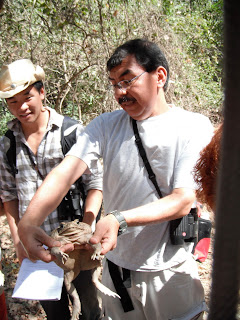
Mau holding a marine toad, which we encountered during our plant walk.
The next day we spent the morning walking around the park with our professors, learning about the plants that we saw. We have another plant test while we're at this site, so this was our first introduction to the new plant families we will be responsible for identifying later on in our stay here. 

This toad peed out (exploded would be a better word) about half of its body volume while I was holding it! Haha
In the afternoon, we had a lecture about ant/plant interactions. Acacia trees are common in Palo Verde, and you can see firsthand the acacia/ant mutualism that biology textbooks often reference when discussing symbioses.

An acacia tree with the ants that live on it. The plant provides a home (the hollow thorns) and food (nectar and protein-rich growths on the tips of leaflets) in return for the protection against herbivores that the ants provide. The ants are aggressive with biting mouthparts, and will attack anything that touches the tree they live on.
The marsh at Palo Verde, which is very close to the station where we're staying.
 After class I did some more research for my ethics presentation, which was about data manipulation and scientific misconduct in general. At 5 a few other students and I hiked up to a lookout point (mirador) behind the field station to watch the sunset, which was awesome! The sky here turns purple-ish around sunset, and from the lookout point you can see really far across the lowlands. We made it to dinner a little late because climbing down the sharp rocks took a lot longer than climbing up them did, but it was worth it. After spending some more time putting together the ethics presentation, I went to bed.

The view from the lookout point
The next morning, we drove to an agricultural region just outside of the park. While the dry forest is not normally a good place to grow crops because it's so dry in the dry season (duh), a dam was built about 30 years ago that redirects water from a river on the east side of the mountains down into the western valleys, providing water to the Guanacaste region of Costa Rica. Because the soil is relatively fertile, adding water allowed people to begin growing high-input crops like rice, sugarcane, and melons. We talked to a farmer and got to see a large rice field and a sugarcane field, although the cane had just been harvested and the field burned, so there wasn't much to see there. The rice field was pretty cool to see, though, and I especially appreciated getting the opportunity to talk to the farmer who owned the land and learning a little bit about how and why he became a rice farmer, where he gets his seeds, how he manages his land, and what happens with the rice that he harvests. Interestingly, banks will only give loans to farmers who use them to buy seeds from certain companies, so the banks essentially control the types of rice that gets planted. The types of rice that get planted furthermore determines the type of input needed to grow it. The seed companies that farmers are allowed to buy from are genetically modified to resist the herbicides that the farmers use to kill weeds, and the seeds themselves come with certain agrochemicals that the farmers then need to put into the system in order to obtain maximum yields. I'm not against genetically modified crops or non-organic agriculture in principle, but I do think it's interesting when farmers get more or less financially cornered into growing food a certain way.


A rice field flooded with water just outside of Palo Verde.
After our afternoon classes, we put the finishing touches on our ethics presentation, while people who weren't presenting had free time. We gave our presentation and led the discussion after dinner, which went relatively well. We focused on three factors that we believe can cause scientific misconduct: funding, career pressure, and advocacy. It was interesting to hear people's perspectives about how all of this relates to our potential futures, and how you can benefit personal needs (e.g. salary, career advancement, and personal beliefs and values) with scientific ethics.

We had a free day the next day, and didn't need to go to sleep as early as we normally would, so some of us decided to take a walk around the marsh at night. We saw some cool wildlife, including crocodile eyes (you can see them reflecting back at you at night, even when you can't see their bodies!), some amphibians, and a snake!

One of the frogs we saw
A snake! Not venomous, to the best of our knowledge.
After returning from the marsh, I played a round of poker with a group of classmates before going to bed around midnight. (So late! Haha.) Even though we had a rest day the next day, we have our first independent projects at Palo Verde, so I wanted to have a productive day of exploring the park and beginning to think about project ideas.

Thursday, January 27, 2011

San Jose

(Click on all images to see larger versions.)
Flying over the coast of Nicaragua shortly before landing in Costa Rica
My flight got in a little late because, in the cold weather in Newark, the water in the plane froze up and then had to be defrosted for about 30 minutes before we could leave. After landing, we (there was another OTS girl on my flight) went through immigration and customs, and then found one of our professors waiting for us at the exit. Instead of leaving immediately, we waited at the airport for another two hours for two other girls whose flights were coming in around the same time as ours. When all four of us had arrived, our professor, Erika, brought us back to the hotel. During the 30 minute drive, I started to get a feel for what Costa Rica is like: lots of motorcycles, horn honking, and fast driving. Houses with tin roofs, houses painted bright colors, even houses made entirely of corrugated metal, orange with patches of rust. Lots of trees and vibrantly colored flowers, and green mountains on the horizon everywhere you look. (San Jose is in a valley, roughly in the middle of the country.) Everyone wearing sandals in January, because it's summer. Birds making exotic birdcalls at all hours of the day and night, even in the middle of the city. It's a pretty amazing place.
Flowers at Hotel Cacts. Top: on a bush on the rooftop terrace. Bottom: directly outside of my room.
We got back to the hotel around 2 pm. It was kind of like a motel by US standards, but because it is in CR it is beautiful. When you enter the front gate into the building there's a normal check-in, but when you go upstairs you realize that, while the rooms themselves are fully indoors, the hallways and courtyards are all open-air. There are plants everywhere, and you can look up from the hallway outside my room and see the stars at night. The dining area is on the fourth floor, which is the top of the building. The tables are under a rooftop, but there is a beautiful patio fully open with plants lining the perimeter. You can see some nice views of the city from there.
San Jose, as seen facing southwest from the rooftop terrace at the hotel.
There are three people to a room, so two of the girls and I were placed in one room and the fourth girl who came back in our group was in the room next door, with her roommates arriving later that day. After we all settled in and changed clothes (we were dressed warmly for our flights, but it was beautiful weather in CR!), we decided to look for a bank so Tessa could take out some money, and a place where Francesca could buy a prepaid cellphone. Finding the bank was easy and quick, although there are hardly any street signs here so I'm unsure how people navigate. The streets have names, but they're just not posted anywhere. We also managed to find the place where prepaid cell phones are sold, even though it was off the map that we had. When we got to the store, the sales clerk tried to explain to us in Spanish that they didn't have any phones in stock, so we bought calling cards instead for 3,000 colones (about 6 USD).

On the way back, we walked through La Sabana, which we later found out is the largest park in San Jose.
A small part of the large park about 15 minutes from our hotel.
In addition to lots of beautiful trees and a few playgrounds, there were countless kids skateboarding, biking, and rollerblading! I haven't seen so much rollerblading since the 90s. In the park there is even a paved area with a roller hockey rink in the middle and a track around the perimeter with slightly banked walls, specifically for rollerblading.

The outdoor rollerskating rink in La Sabana.
When we were exiting the park we passed by what looked like a country club or hotel, but when we came around to the front of the building we saw that it looked like they were setting up for a huge outdoor concert. We didn't know what it would be but we decided to sit down with the crowd (which was already pretty big) and wait for a bit to find out. We stayed for 40 minutes but the music never started and we had to head back to the hotel for dinner at 6.
The (as of yet) mystery concert near the park.
We found our way back to the hotel with no problems, although another funny thing about San Jose is that since the streets aren't marked clearly, places are identified by landmarks. For example, our hotel has a street address, but really what you need to know in order to get there is that it's 200 m north of Pizza Hut. I love how that is perfectly acceptable here. It's so funny.

At dinner we met up with the other people in the program who had arrived. We had 18 of 28 students by then, with the rest arriving from the airport after dinner. Overall I like everyone I have met in the program. In addition to meeting other somewhat eco-nerdy college students from the U.S. (which I was expecting), we have two Costa Rican students in the program, which is awesome.

After dinner we decided to go back to the park to see what the concert actually was, since we left before it started. It turned out to be incredibly eclectic, with performances ranging from Latin American pop to emo/punk to a capella to rumba. We left after about an hour and a half because most of us had been traveling all day and running on little sleep, and got to know each other a little more on the walk back to the hotel. Some of us stayed up on the rooftop terrace and drank tea and talked some more before going to bed.

The next morning, we had an early breakfast (rice and beans, aka gallo pinto, and fresh fruit) and headed to the OTS office on the other side of San Jose for orientation. The building is beautiful, with lots of plants indoors, like the hotel. We spent the morning doing regular orientation stuff like introducing ourselves, going over the course materials, and inventorying our equipment boxes.

Inside the OTS office at the Universidad de Costa Rica.
After a lunch break we took a Spanish language placement test so they know what level classes to put us in when we come back to San Jose mid-semester, and then headed back to the hotel. We had a few hours of free time, and then went out for dinner as a group to a Costa Rican-style restaurant. That was nice, since we had pizza for dinner the night before. The food was good and it gave us a chance to interact with people we didn't know yet.

After dinner we returned to the hotel and then decided to go out as a group to a discoteca, since it was our last night in the city. I think that almost everyone decided to come along, and we somehow managed to find the place despite San Jose's winding and effectively nameless streets. After a fun night of dancing to both American and Latin American music, we took taxis back to the hotel, packed up our bags, and went to sleep. The next morning we departed at 7:45 for our first field station: Las Cruces!