Friday, February 25, 2011

Cuerici, pt. 2: El Paramo

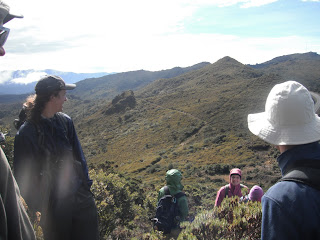
Sunday morning, the groups switched; the rest of the class hiked the oak forest, and my group went out to the paramo. The paramo is unique ecosystem found mostly at high elevations in the Andes of South America, but (luckily for me) the northernmost examples of paramo can be found in Costa Rica. The paramo is defined as the region at high elevations in between the treeline and the snow line, and is inhabited by plants with lots of weird adaptations to survive the extreme climate. Because it's so high up, there is literally less atmosphere above to block out the sun, so it is hot and harsh for much of the day. However, like Cuerici, it is really misty, and when the clouds roll in and block out the sun it gets really cold really quickly. Also, it's windy pretty much all the time. One of our professors described the paramo as "summer at day, winter at night," and after seeing it for myself I would say it's a pretty accurate description.

Some of the cool adaptations we saw:

This plant has white "petals" that bounce light into the black center, allowing the little flowers to heat up. Rather than providing a more typical incentive for pollinators (e.g. nectar), insects are enticed to stop on the flowers to warm up when it's cold outside.

Lots of the plants have really reduced leaves to prevent dessication from the constant wind. The leaves are also arranged differently to help retain heat and moisture. Lots of plants have fuzzy leaves to create more of a "boundary layer" that holds in water and even reflects light, since the sunlight is so direct when it's not cloudy.

We had a guide accompany us for the day, which was cool because she grew up in the paramo and has learned everything she knows about it just by exploring it as a child and studying it as an adult. Her parents were U.S. citizens who moved to Costa Rica (which has no military) before she was born so that she and her older brothers wouldn't get drafted in the Vietnam war. She led us around the paramo all morning and taught us about the plants that we saw, many of which have medicinal uses. Learning about the paramo plants was awesome, but more than anything else I enjoyed the beautiful and often bizarre views. It truly is unlike any place I've ever been before. 

On our way up near Cerro de la Muerte
Early into the hike we found a skink on a rock, and it got a lot of attention from us! Haha. While there are lots of awesome plants up there, it's harder to see animals since not many live there permanently; they just visit and feed during the day and avoid having to tolerate the extreme cold at night. Skinks will bite onto things in self-defense, and our guide demonstrated this by allowing it to hang on her ear for about ten minutes while we all took pictures.

Our paramo guide, with a skink on her ear
Anna holding the skink
We climbed a good deal during the hike, ending up around 3,400 m above sea level. The air really is thinner at that elevation, but my group was not as winded as we expected since we had already hiked the oak forest the day before and gotten used to it a bit. It was clear for a good deal of the time we spent in the paramo, but when we got up to the very highest point it was extremely cloudy! The group that had visited the day before had perfectly clear views and came back with beautiful pictures, but pictures can't really do it justice anyway... Instead, I got to see a "real" paramo view: misty, eerie, and incredible.

Classmates on a hill, with minimal clouds

Misty, eerie, and incredible, right?

We found another skink at the top, and took some more pictures of it.

Chesca, my tica BFF, and I at the highest point that we visited. It's like we're standing in front of a wall of clouds. You couldn't even see over the edge right behind us.
Coming down through the clouds

Miguel and my professor Susan on the way back to the car, though a bunch of grasses and flowering bromeliads
Justin, Chesca and I were the last ones back because we stopped to look at some sphagnum moss and listen to birdcalls.
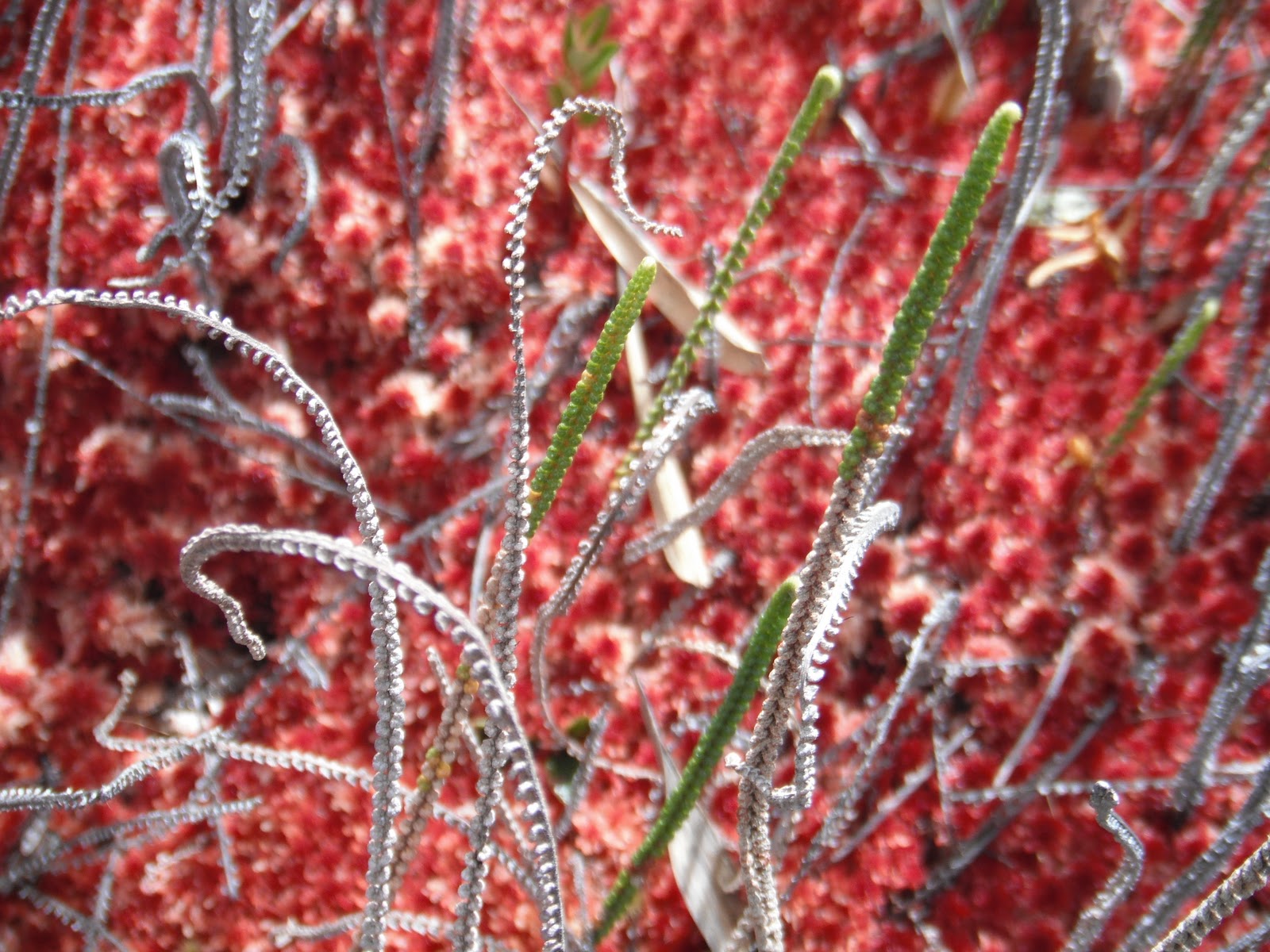
Sphagnum moss. Where water accumulates in the paramo, little boggy areas appear. Walking on them feels like walking on a memory foam bed.
We made it back down!
I know I said that the oak forest hike the day before was one of my favorite days in Costa Rica yet, but less than 24 hours later I think I exceeded my previous level of amazement already. The paramo is an incredible ecosystem that's totally different from any other place in Costa Rica; it's amazing that we could go from a relatively lowland rain forest to this bizarre, beautiful, almost alien environment in just a few hours!

Cuerici, pt. 1: The oak forest


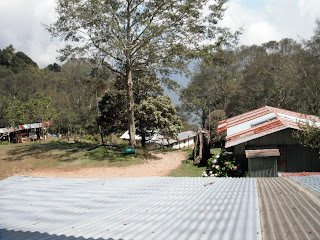
Friday morning, we left Las Cruces and headed out for Cuerici. It was several hours away by car, and the big bus we took couldn't make it the whole way because the last part was on a steep and rocky dirt road. Don Carlos, the owner of Cuerici, and Don Alberto, his assistant, met us at the end of the road with a large truck that we loaded our big luggage onto, which was convenient because we didn't have to carry all of our stuff the last 5 miles to the station. As soon as we got there, it was pretty apparent that Cuerici is awesome. It's at a high elevation (~2,500 m) and in the Talamanca mountains, so the climate is way different from anywhere we'd been so far. It was sunny and breezy during the day, with misty clouds being pushed up the mountainside so that it feels slightly damp and cool all the time, in a good way. While it's still a wet forest, it's totally different than the forests we've seen before. Because of the higher elevation, the primary forest is a mix of oak trees and bamboo, with bromeliads and other epiphytes present but less common. Basically it looks kind of like a temperate forest, but more magical! Haha. 

When we first arrived, we moved our stuff in and had a brief orientation talk. Instead of having separate rooms like Wilson House at Las Cruces, the whole second story of the building was essentially one big room filled with bunk beds. There were thin dividers splitting the room into three rows of beds, giving us some privacy, but they didn't go all the way up to the ceiling so you could hear the people nearby even if you couldn't see them. In other words, there was not much privacy, which really wasn't a problem since we were only there for a week. It was kind of like being at summer camp since all 28 of us were in such close contact, which was fun.
My bed in Cuerici. I definitely needed the sleeping bag... it was COLD! Note: the top shelf is all of the clothes I have for the entire semester.
View from the bedroom window, looking down the mountain
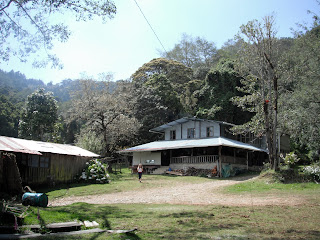
The station, as viewed from the lawn
Patrick in a hammock chair on the front porch
Once we were settled, Don Carlos gave us a tour of the property. We started out going through the agricultural part of the land, where he grows things like vegetables and berries and grazes cattle. We also followed him briefly into the woods and got to see a generator that he built himself to harness some hydroelectric power for his house and the station. Then he showed us his trout farm, which is his main source of income (being the director of the biological station doesn't pay enough to support his family, so he does this on the side). It was really interesting to hear him describe how he manages the fish farm, from extracting eggs, hatching them, and raising them to preparing them to be killed and eaten. It was especially cool to learn about how he made his farm sustainable in various ways, like using old compost worms to feed the trout, and then taking sediment from the trout ponds and canals and using it back in the compost.
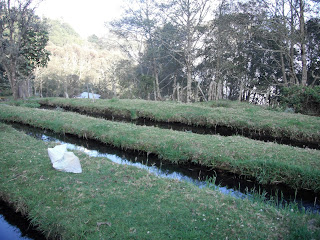
Some canals for older fish in the trout farm
That night we had a bit of free time, and a bunch of people wanted to watch a movie. I decided not to since I was already really tired (I hadn't gotten much sleep the night before while getting ready to leave Las Cruces!), and instead worked on a statistics homework assignment with Chesca and Miguel. We actually had a very good time doing our homework together, and it was nice to get the assignment done a week early.
The next morning, we split up into two groups again to be a more manageable size for talks. One group went out to the paramo (there is an accent over the first a, but I can't get it to show up on here), and my group went for a long hike up into the oak forest. We used the same groups that we'd formed for our visit to Don Roberto's farm, splitting based on Spanish proficiency. Don Carlos's talk was, therefore, entirely in Spanish. He is a very kind, thoughtful, and deliberate person, and I found him even easier to understand than Don Roberto. He took us through some secondary fores that he had restored from his grandparents' cattle pasture, which presently consists mostly of magnolia trees and alders. Then we entered the primary forest, which is made up largely of two species of oak and two species of bamboo.


Don Carlos talking about oak trees


The primary forest there serves as a corridor between other preserved areas, meaning that some large animals pass through there. Don Carlos said that peccaries, tapirs, and even pumas travel through the Cuerici reserve. I was surprised to hear that pumas were out there, since the only place we've been so far that is large enough for pumas to have territories was Las Alturas, which was contingent to a HUGE reserve (500,000 hectares). But, we actually saw puma poop while we were on our hike, so Don Carlos was definitely right, which is awesome!

Puma poop, full of peccary fur!
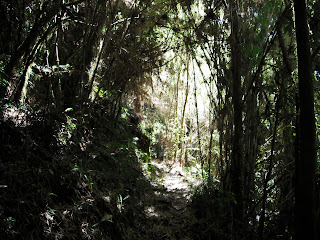
Bamboo forest!
After we had gained about 300 m in elevation, we arrived at a glorious lookout point facing the Talamanca mountain range. You could see a town down in the valley and watch the clouds pass between the mountains. It's hard to describe how beautiful it was, and even the pictures I took don't really do it justice.
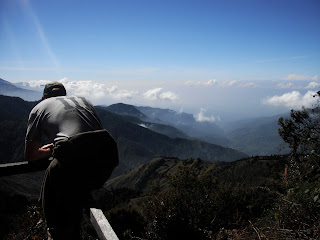
The view from the lookout point, mancas
Orchids up on the mountain
After enjoying the view, we began to head back down to the station, stopping to talk along the way whenever Don Carlos saw something interesting. Overall it was an excellent way to spend a morning, and was probably one of my favorite days yet in Costa Rica.
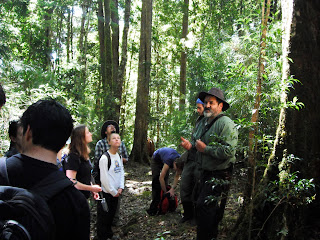
Talking about logging, land management, and balancing human needs with conservation
An oak tree that's several hundreds of years old
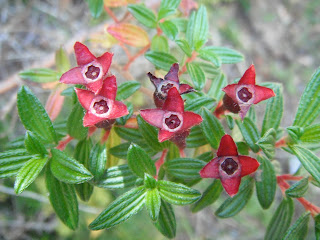
Tiny Melastomataceae flowers

Sunday, February 20, 2011

Las Cruces, pt. 10: El Fin!

Thursday, February 10 was our last day in Las Cruces! It was hard to believe that our time there was already over, especially since two weeks is just long enough to really start feeling settled in. In the morning we had our plant practical, which was basically a test of our ability to identify the 20 plant families we had learned about while we were there. It took about 45 minutes, and then we had free time for most of the day. Our bug identifications were also due that afternoon, but I had finished them a few days before so I had lots of time to do whatever I wanted. I spent the day sitting out on the porches near the dining hall and catching up on some of the assigned readings that I was behind on. I also did some of the next readings in advance so I wouldn't have to worry about homework at Cuerici. It was a really peaceful day and I enjoyed spending some quiet time by myself and appreciating how gorgeous Las Cruces is before we had to leave. Some of my sights from the last day: 

Lots of birds on the deck!


My reader and some tea under the porch during a little rainstorm
We had one final lecture that night, given by a former undergraduate OTS student who's now working on his PhD in Las Cruces. He studies bats and gave us a really interesting lecture about their role in forest regeneration in Costa Rica. Afterward, a few other students and I walked out with him to look for some bats in an abandoned research shack where they nest. We saw a few, but since we were a larger group I think we scared most of them away before we even arrived.The coolest part of the whole thing was hanging out with someone who started out in the same program that we're in now, and seeing the interesting research he's doing now and how much fun he's having.

The rest of the night was spent packing up and getting ready to leave. It was a little sad because Las Cruces was so lovely, but I was definitely excited to explore somewhere new!

Saturday, February 12, 2011

Rest Day 2: Boruca!

After a day dedicated entirely to the ESP surveys, we had our second day off! Tuesday night after our classes were over (finally... we were "debriefing" until almost 9:00!), we went out again to 'S'Lugar, the bar in San Vito. It became very apparent that they only had one "American" playlist, since all the music we danced to was the same that we'd heard last time we went out. We had a good night anyway, filled, as usual, with lots and lots of dancing.

The next morning most of us were up early and on a bus at 8 am to Boruca. Since it was our rest day the trip was optional, but only 4 or 5 people stayed behind. Everyone else decided to go on the trip since our professors arranged it for us and it seemed like a cool opportunity to check out a different rural area that we probably wouldn't be able to get to otherwise. Boruca is a small indigenous village that is known for the elaborate arts and crafts made by its residents. We arrived there after a two hour bus ride, and immediately began learning about the history of the village and people from a woman who lived there. After about an hour of history, she demonstrated of how the village's colorful woven products are made, from start to finish. She began by picking some cotton from a cotton plant, removing the seeds, and spinning it into thread. Then she showed us how to dye the yarn all different colors using parts of plants that they grow there. Basically, the plants (either boiled or fresh) are crushed up with wet yarn and the color is squeezed into the thread by hand. Then the string is left in the sun to dry. The sun-drying also intensifies the colors; it was really cool to see the blue yarn get darker and darker just in the short amount of time we were standing there.

Dying the yarn

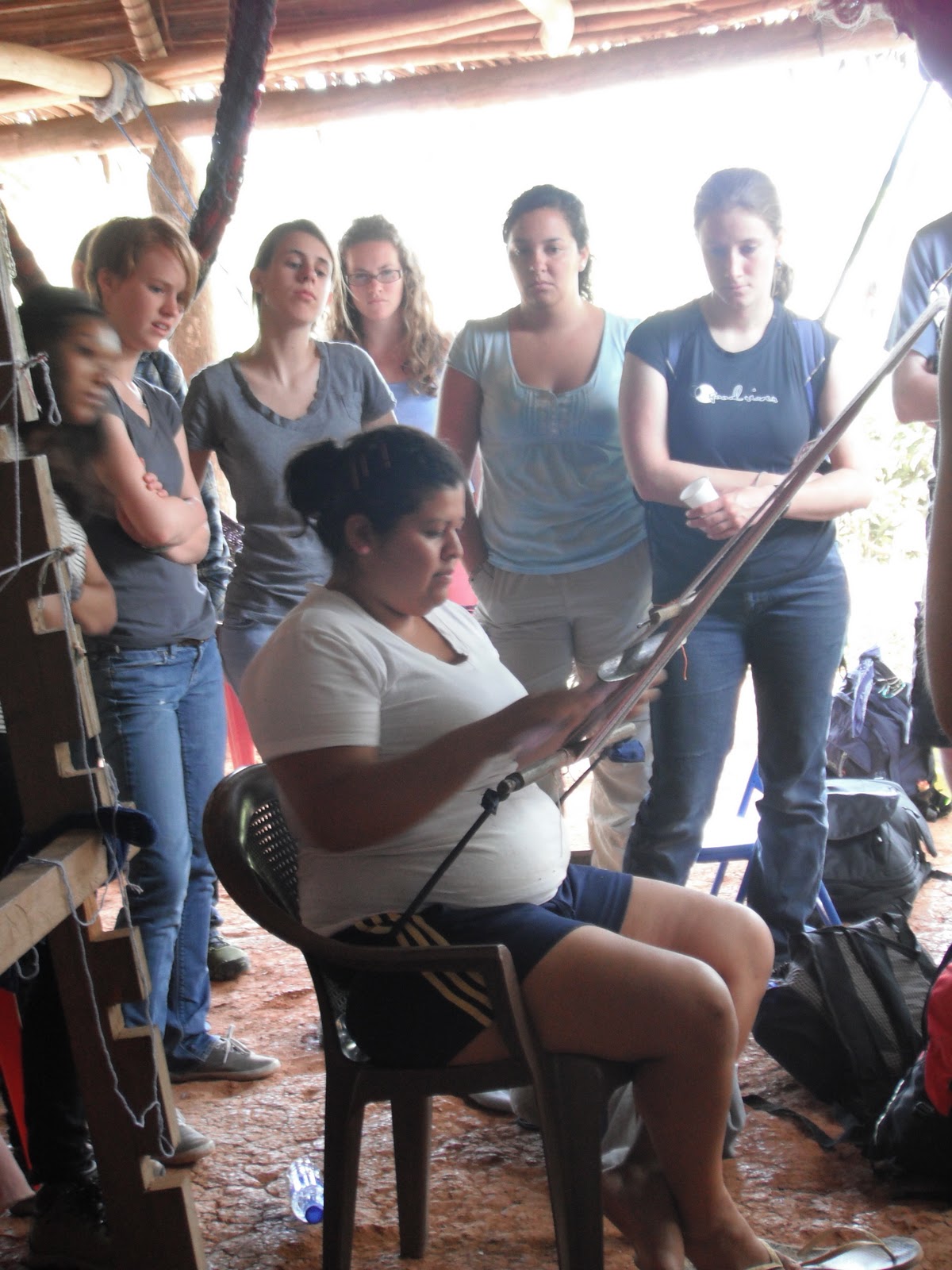
After the yarn-dying, the women used some dry yarn to show us how they wove the fabric that they use to make clothing and souvenirs that they sell to tourists. The process was really complex and a little difficult to understand, but it was amazing how quickly and precisely the women could weave! One of the girls said that she had been weaving since she was about 8 years old.

Weaving!

Besides weaving, Boruca is most famous for its masks. When the Spanish first entered Costa Rica, the indigenous people began to carve grotesque masks out of wood to scare away the invaders. The mask-wearing tradition persisted over time and became symbolic of warding off the devil, and every year the villagers have a traditional ceremony in which they wear the masks. For a while the tradition almost died out, but the village had a revival of traditional crafts when increased tourism to the area created a profitable market for their goods. Now tourism and craft sale are the main sources of income for the village.

Some of the masks for sale

After spending several hours in the village, we took our pack lunches and drove a bit out of the village to a waterfall. We spent a few hours eating, swimming, and enjoying the views, before heading back to Las Cruces.

View from the top of the waterfall

The pool at the top of the waterfall where we swam

Friday, February 11, 2011

Las Cruces, pt. 9: Environmental Services Payments

After visiting Don Roberto's farm and having learned about the Costa Rican system that provides monetary incentives to individual landowners for conservation and reforestation, we had the interesting experience of helping out with a survey of landowners regarding their knowledge of, participation in, and satisfaction with Environmental Services Payments. Some representatives from CATIE, a Costa Rican NGO that studies agricultural issues, came out to Las Cruces and presented us with a draft version of a survey they hope to launch in a few months. All Tuesday morning we went through the survey to edit it and practiced asking the questions in Spanish. After lunch we broke up into small groups and went out to interview people. My group and two other groups took the OTS car into San Vito, since we each had a pre-arranged interview with one of three brothers that owned a farm together just outside of the town. Despite the fact that it's the dry season, it started POURING as soon as we got to San Vito. All 15 or so of us got stuck under a bus stop and had to wait about an hour for the rain to stop before we could head over to the farmers' house. 

Hiding from the rain under the bus stop.
 The surveys went relatively well, although the version we were using was still definitely a rough draft and it was a little awkward tag-teaming one farmer with a group of six interviewers that didn't speak Spanish very well. The whole event wasn't organized very well, but it really was cool to go out and hear people's real experiences with the ESP program. Marvin, the farmer we interviewed, was receiving payments for conserving forest, and overall seemed satisfied with the program. A lot of landowners that other groups interviewed had contracts to be paid for their conservation efforts but didn't receive the money they were promised. Some landowners had never heard of the ESP programs, and others knew about them but didn't have contracts because they didn't want to or didn't get approved. When we got back, we typed up our results, debriefed as a group, and talked about our experiences with the farmers and suggestions about the survey in general.

While out doing surveys, we also saw this cool tree that has red sap! Supposedly in the old days, people used it as toothpaste.

Las Cruces, pt. 8: Don Roberto

Our first day back from Las Alturas, we spent the morning visiting Don Roberto, a farmer that lives about 20 minutes away from Las Cruces. We went in two groups so that we could get a more intimate experience at the farm, and split based on Spanish ability so that our professors wouldn't have to translate everything twice. I was on the fence about which group to go in, but the advanced Spanish group had fewer people signed up for it, so I decided to go with them to try to even out the numbers. So, when we toured Don Roberto's farm, our whole talk was entirely in Spanish. I was a little nervous that I would be totally clueless since my Spanish is still rusty, but I think I understood about 80% of everything he said, so I was pleased in the end. 

Don Roberto owns a small farm, but grows a variety of crops. When we first arrived, he demonstrated how to extract the juice from sugarcane, which you can drink straight or ferment into cacique, a sweet liquor that is common in Costa Rica. We got to try the cane juice, but most of us thought it was a little too sweet to drink as is. According to Don Roberto's wife, he drinks about 4 liters of cane juice a day when he is working in the fields. Since it is basically just sugar water, I'm sure it keeps you energized!

Don Roberto (right) extracting juice from sugarcane, with his wife straining it and catching it in a pot.
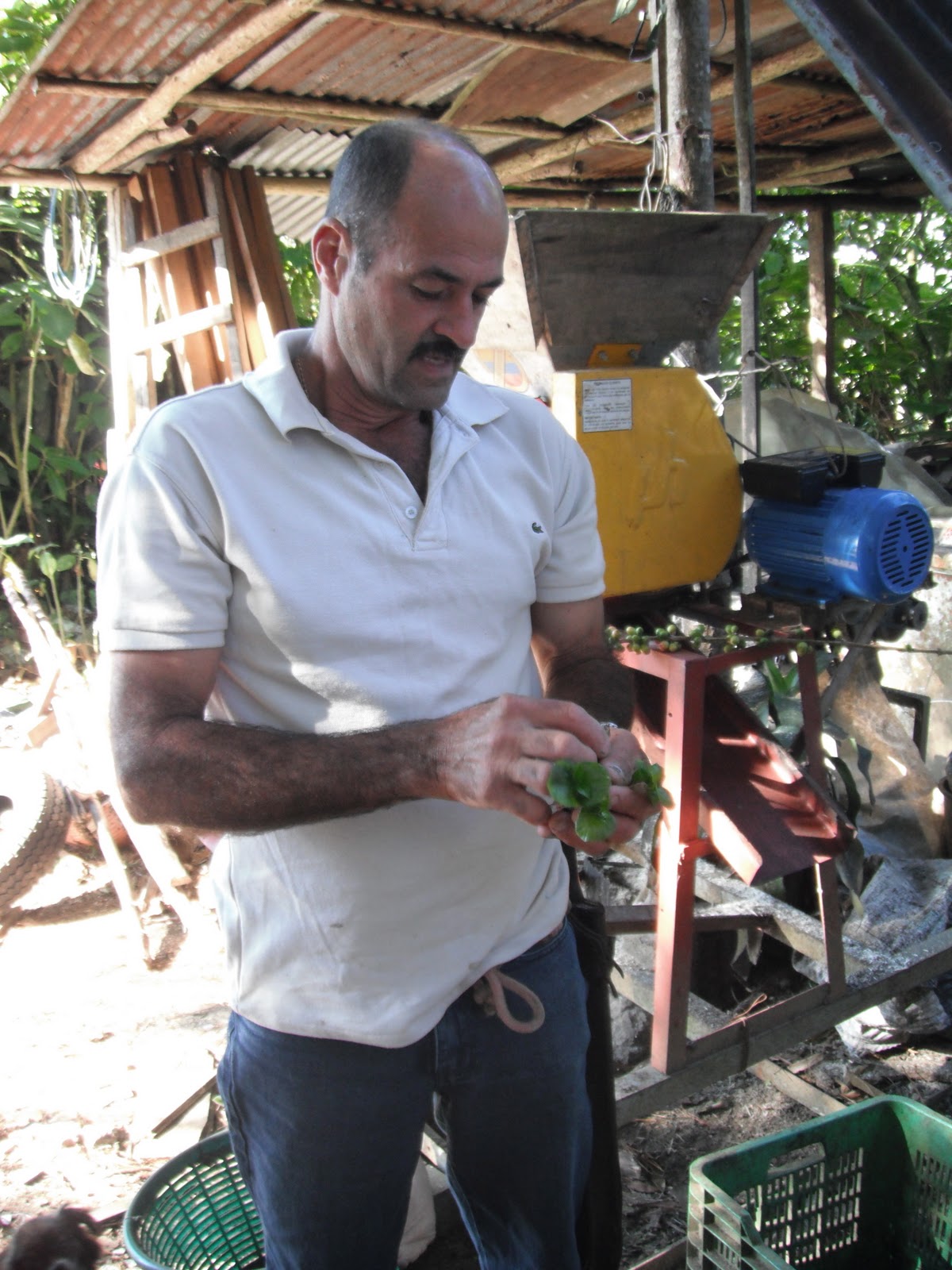
Don Roberto also grows a good deal of coffee, and showed us every step in raising, harvesting, and preparing it. It was pretty cool to see in person, especially since we had been learning about coffee in our classes.


Don Roberto showing us the different size coffee seedlings.
Separating coffee beans from the skin surrounding them.
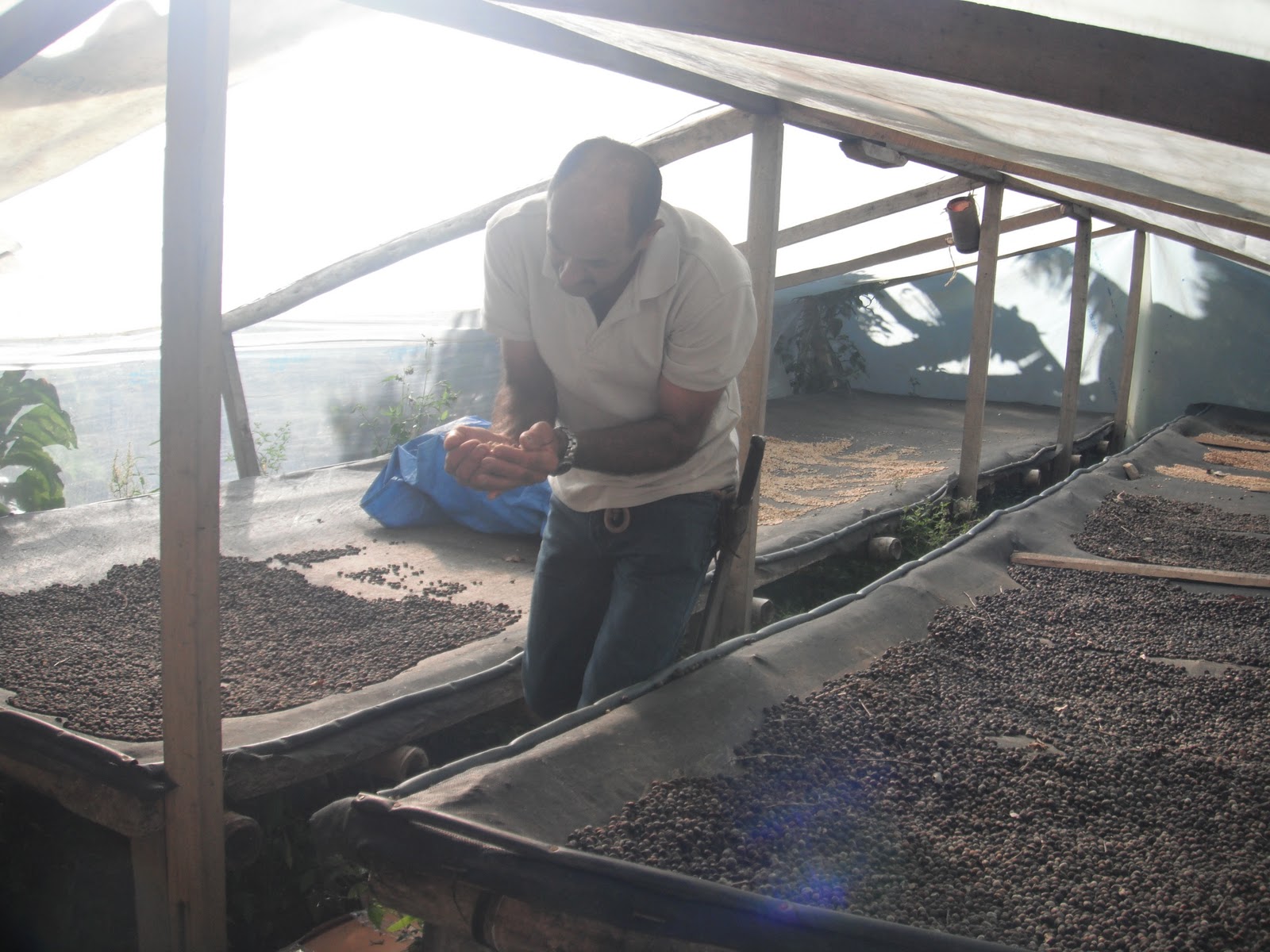
Coffee beans drying in the sun.

At the bottom of his plot of land, Don Roberto keeps some forest. While he is not receiving Environmental Services Payments (which we have also been learning about in classes), he preserves forest on his farm voluntarily. He talked a lot about how his involvement with a co-op changed his perspective on farming (he now uses minimal pesticides and herbicides, and composts to cut down fertilizer needs) as well as conservation in general. He used to use the forested land to graze cattle, but about 18 years ago decided to let the area regenerate naturally. Now it is a nice patch of secondary forest, which helps protect the watershed and provide habitat for animals. It was really interesting to hear how his perspective had changed over time and how important he felt that maintaining a balanced and well-informed personal mindset is on allowing people to both make a living and be environmentally conscious.


A field of beans

Quick update

So, in about 20 minutes we are headed to Cuerici, where we won't have phone or internet access for the next six days. I didn't have a chance to finish the last two posts before we have to start loading the car with luggage, but I got a chance to put the pictures up. More details about the end of our stay at Las Cruces will come sometime next week, when we return to San Jose.