Sunday, April 3, 2011

Palo Verde, pt. 4: Independent projects

At the beginning of FLP week, I still had no solid idea to work with for the upcoming independent project. I knew that I was vaguely curious about trade-offs in anti-herbivore defenses in acacia trees, wondering if species with obligate ant interactions produced lower concentrations of secondary compounds than species with facultative ant interactions. However, I had talked to my professor Erika about this idea and she told me that because there are only about 4 species of acacia at Palo Verde, I wouldn't be able to gather enough data to make generalized conclusions about the potential trade-offs between biotic and chemical defenses in plants. I was also interested in the agroecosystem in and surrounding the rice fields that we had visited earlier for class, but didn't at first see any connection between these two ideas. However, at some point during the week it clicked for me, and I decided that I wanted to study anti-herbivore defenses in non-agricultural plants near the rice fields, predicting that they would have decreased defenses because of agrochemical use lowering the herbivore pressure in the region. Once I had my idea formulated, I talked to my professors about it and they gave it the OK. Rukhshana and Owen also decided to work with me, so by Thursday we had a team, a question, and a plan of attack.
Rice fields near Palo Verde where we did our IP
Wastewater flowing out from the flooded fields
The wastewater, contaminated with pesticides, flows out from the fields in exit canals like this one. The big trees on either side of the canal are guazumas.
 After our FLP presentations on Thursday morning, a bunch of students including me, Rukhshana, and Owen took a ride back out to the rice fields to make preliminary observations for the IPs. Most people were still looking for a question to work with, but we were out scouting for plants with quantifiable anti-herbivore defenses that grow abundently near the rice fields. We took about 20 samples and brought them back to Palo Verde, where the three of us met with our professor Susan. Our original plan was to compare plants near the rice fields to plants at Palo Verde, so Susan helped us sort through and identify our samples, pointing out the plants that plants that we might also find in the park. Unfortunately most of the abundant non-agricultural plants in the rice fields are weeds that don't  grow much in Palo Verde, so we had limited options to work with. However, we did notice some familiar faces growing along the edges of the irrigation canals in the fields: Guazuma ulmifolia, a large tree with trichomes on its leaves, and Vachellia collinsii, an acacia species that depends on agressive ants to protect itself against herbivores. Trichomes are like little tufts of hair on leaves that help prevent dessication and also discourage insect herbivory by making the leaf fuzzy and difficult to bite. Because they are discrete, they can easily be quantified just by counting their density using a dissecting microscope with a grid. The acacia trees use extrafloral nectaries (EFNs) to encourage ant inhabitation, so counting EFNs and measuring their size is a way to quantify the trees' defenses.


Guazuma trichomes, as seen through a dissecting microscope.
Vachellia extrafloral nectaries (EFNs)
To make our experimental design more robust, we wanted to find a third plant species to examine, and do some sort of additional analysis of chemical defenses on all three species. Unfortunately, one thing that OTS sorely lacks (in my opinion) is good lab space and equipment at the field sites, so most of the chemistry protocols we encountered for quantifying anti-herbivory chemicals in leaf tissue were way too advanced for our situation... The most serious equipment we had were mortars and pestles, and the most heavy-duty chemicals we could get our hands on were acetone, ethanol, vinegar, and  water (tap or bottled, but neither deionized or sterile). Needless to say, we were feeling pretty limited. When it came time to present our proposal on Friday morning, we still had not worked out the details of the third plant species or the second test we'd be using.

Regardless, we started to work. Data collection officially started on Saturday, but we spent the afternoon walking around Palo Verde and looking for forest edges facing the same direction as the irrigation canals in the rice fields. Because trichomes on leaves also help prevent water loss, it was important that our control site plants be getting approximately the same exposure as our plants at the fields. While we were flagging usable trees with fluorescent tape, something amazing happened: it rained! In the dry season! And when I say rained, I mean it POURED. After having been at Palo Verde for over a week already and sweating almost constantly, everyone was ecstatic. We all ran back to the building, dropped what we were doing, and sat in the rain, ecstatic. It felt amazing, and was a welcome last bit of freedom before the true work of IPs began the next morning.

Enjoying the rain on a hot and muggy day

Like I said, it was pouring!!! Miguel said that this is what the rainy season is like every day. I can't even imagine!
At dinner, we talked again with Susan, who told us that we should find a new control site closer to the rice fields to use in our experiment. Because Palo Verde is about 30 minutes away by car and is also partially wetlands, the soil types between the rice fields and the park are very different, and our professors thought it would be better to try to eliminate that as a potential confounding factor. So, the next morning when we began collecting samples, we went to a new site northeast (upstream of wastewater exit canals) of the rice fields and got 21 samples of vachellia. We needed 30 samples at each site with three individual leaves per sample, and getting just 21 took all morning because of the ants. As it turns out, vachellia's biotic defenses are pretty effective against herbivory, and all other sorts of threats. As soon as you touch a leaf to snip it off and take a sample, the ants come running down the stem and attack, biting all over your hands (or wherever else they land). We had to be really careful, and even so we still got eaten alive, literally. We came back for lunch and went back into the fields at 1:30, getting our 30 samples from the rice fields and our 9 remaining control samples. After dinner Rukhshana, Owen and I spent lots of hours up in the lab building counting and measuring the extrafloral nectaries on all 180 vachellia leaves, and then enetering our data into a spreadsheet. We also had decided on an herbivore preference test for chemical defenses, which our professors recommended because of the relative ease of the protocol. The general idea is to make a crude leaf extract and present it to ants, and see how much the ants eat compared to a sugar-water control. So, on night 1, we also made an ethanol-based extract from vachellia leaves from both sites. By the end of the first day, we were already exhausted!

The next morning, Owen and I went back out into the field to collect our guazuma samples. Rukhshana stayed behind to do our ant bioassays for the vachellia leaf extracts, which we had to repeat on 20 different ant colonies of the same species. Because another student needed to be driven to a different off-campus site to gather data, the driver couldn't stay with us all morning like he had the day before, and dropped us off at the control site. We collected 30 samples from our control site, and then started to walk to the rice fields since we weren't getting picked up until later that afternoon.

Owen climbing a tree to get a guazuma leaf sample
Unfortunately there are a LOT of rice fields near Palo Verde, and they all look really similar, so we got lost and were wandering around the roads for THREE HOURS, all while carrying around a garbage bag full of leaf samples and an 8-foot long pole pruner for clipping high-up branches. We realized in retrospect that we had walked all the way around the entire region because we missed a turn down the road that took us to the fields we were working at, and by the time we found our way back to the right place by walking back to Palo Verde and going back out from there, the driver was already waiting to bring us back. He doesn't speak any English and we were too hot and exhausted to explain what had happened in Spanish, so since we weren't sure whether or not someone else needed to be driven somewhere in the afternoon, we went back to Palo Verde with zero of the 30 samples we needed from the fields. After a bit of rest and SHADE (which does not exist in rice fields), we went back out for two more hours and collected all 30 of the samples we needed. I took the most glorious shower of my life when we had finished our hot and exhausting field work for the day, and ate a very satisfying dinner. Then I spent several hours counting the trichome density on some of the guazuma leaves, since lack of microscopes and issues of inter-observer reliabilty prevented us from sharing the work among all three of us. While I was counting, Rukhshana and Owen made the leaf extracts for the guazuma samples. Because I was so exhausted from our crazy day, I only got through about 1/4 of the leaves that I needed to look at, but I decided to just go to bed and finish it the next morning.

After getting some rest, I spent the entire next day counting trichomes at the microscope. Rukhshana completed all of the ant bioassays that we needed for the leaf extracts, and Owen went back out into the field with Susan to try to find a third species that we could use. Miraculously they were able to find one that grew at both sites, a shrub with trichomes called Malvaviscus arboreus, and collect the 30 samples from each one all in one day. I finished counting trichomes around 8:30 pm (seriously!), and handed off the trichome-counting responsibility to Owen for our malvaviscus samples. While he was working, Rukhshana made leaf extracts and I assembled a datasheet for our grazuma trichome information. We were all tired again, and Owen and I had gotten sunburn while lost the day before, so we went to bed at 9 pm, which felt wonderful.

Rukhshana observing ant responses to extracts made from leaves near the rice fields, far from the rice fields, and a sugar control.
By counting the number of ants present on each petri dish after a certain amount of time and dividing by the number at the sugar control, we could determine the relative palatability of the leaf extracts. A leaf extract that is less palatable to herbivores presumably contains more chemical defenses against herbivory.
Tuesday was our last day of data collection for the IP! Owen counted trichomes all day, literally from about 8 in the morning until about 1 am the next morning. Rukhshana and I did the remaining ant assays, and I started analyzing whatever datasets were complete. We met with Susan, and realized that we had significant results! She was very excited for us (as were we!), and it was amazing to comprehend that we had actually accomplished something both interesting and kind of important in just four days. The next day was dedicated to finishing our analyses and putting together our results, whichw e had to present on Thursday. We met with Susan several times to create our Powerpoint and interpret our results. The next morning was spent rehearsing our presetation, which we gave that afternoon. As soon as the presentations were done (which were really neat to listen to, since everyone had done completely different projects), we had a little bit of time to break down everything from our experiments, i.e. washing some glassware and un-flagging the 20 ant colonies we had used for bioassays. After dinner, I started writing my lab report rough draft, which was due the next day! I stayed up all night and it took me until 6:15 the next morning, but I finally finished, just in time for the first break we had had in a long time.

Palo Verde, pt. 3: Faculty-led projects

Tuesday 2/22 through Thursday 2/24, we worked on faculty-led projects with Jordan, a professor from Tulane, and Ignacio, a graduate student at the University of Costa Rica. On Tuesday and Wednesday we did data collection, splitting up into two groups and working on one of the two projects each day. I worked on Ignacio's project first, and collected data on Green Lynx Spiders all day. We were testing to see whether spiders gain experience with age by looking for relationships between spider age (juvenile/adult) and responses when encountered with a predator.


A green lynx spider (Peucetia viridans)
Ruellia inundata, the plant where green lynx spiders live. Rather than building webs, they perch on the plants, wait for pollinators to pass by, and then pounce on them.
We did this by simulating predation with a false bird beak (aka a stick sharpened to a point and wrapped in black electrical tape) and measuring how close we could get to the spider before eliciting a response, the response distance, response type (run, jump, shift, etc.), and response location (leaf, stem, flower, or ground). 

A "simulated predation event." Chelsea is moving the stick, or model bird beak, towards the spider, and Carolyn is waiting to measure and record its response distance and type.Photo by my professor, Mau.
While 14 of us were gathering data all day, a smaller group of six was responsible for compiling all the data, writing it up, and presenting it to the class. I was in the small group for Ignacio's project, so after a long morning of finding, poking, and observing 50 or so spiders, I spent the afternoon making a giant dataset of all of our observations from day one.

On Wednesday, the other group was collecting spider data with Ignacio, and my half of the class went with Jordan to work on his project. He was observing bird behavior based on population density to see if behaviors that decrease vigilance toward predators (e.g. foraging) is more prevalent in areas of higher bird density, overall looking at the osts and benefits of social behavior in birds. We spent the day observing Northern Jacanas at three different sites in Palo Verde, focusing on one individual at a time for five minutes of observation. We worked in pairs so that one person could record the behaviors that the person with binoculars observed; however, I was working with Rukhshana, and she got sick that morning, so I ended up working in a group of three with Ashur and Inca.


A really terrible picture of Jacana spinosa, the Northern Jacana. If you look closely you can see one on the right hand side about half way down. Everything else in the picture is water hyacinth in the marsh. Northern Jacanas are actually really cool looking, and Google images can probably show you much better stuff than this!
Birdwatching in the marsh at one of our lookout points
Justin simulating the Jacana's aggressive wing-display behavior on Matt.
The big croc!
Because both small groups had to present on the research the next day, we only gathered data in the morning so we could work on analyzing the data later in the day. Although we were only out for about five hours, it was an exciting morning. First, Inca got chased by a herd of cattle that live out in the marsh to keep the invasive grasses under control, which was scary! Then, at our last observation site, we saw some crocodiles out in the marsh from the bird observation tower, which was really cool. We found a small one at first but then went back down onto the ground to tell other people, and Ashley came over and spotted one that was at least 6-8 feet long off in the distance. We watched it for a while as it swam around in the marsh and over to a flock of whistling ducks, which we thought it might try to attack. Unfortunately we didn't get to see the crocodile eat anything, but it was awesome to watch nonetheless.

After lunch,  I spent the afternoon compiling the second day's spider data and running statistical tests on the complete dataset. I gained a lot of respect for professors like Bob Kaplan at Reed, who have to piece together huge datasets for class-wide ecology experiments... it's hard work! You have to be very careful to try to notice errors in data input by all of the contributors, figure out what they did wrong, and fix it, as well as making sure everyone's data is consistent in units and format. It took me a few hours just to get everyone's data into a usable form to run statistical tests, since for some of the observational components (e.g. response type) people had recorded a lot of things that were not in our list of options or were entered differently. When the dataset was complete, I spent the rest of the afternoon analyzing it with eight different tests. Then after dinner my group of six met to discuss and interpret our results, exchange notes on some literature we had read, and put together our presentation to give the next day. It took a long time to get everything together, but we finished up our presentation by midnight (which is very late for us!). In the end we found that adult spiders had significantly lower predator distances at the time of response than juvenile spiders, and that while some adult spiders had no response whatsoever (they stayed still even when the "predator" was at a distance of 0), juvenile spiders always responded in some way. These suggest that the adult spiders may be better able to identify our "predators" as a non-threat, since they were not entirely realistic replicas of bird beaks and since they were approaching the spider very slowly. This would support the experience hypothesis, that older, more experienced spiders can more accurately evaluate the costs and benefits of fleeing from a predator and losing their perch on the plant, which they require to catch their food (pollinators like honey bees). Our presentation the next morning went relatlively smoothly, and I was impressed that we could actually gather enough data in a day and a half to get interesting results. Prior to the FLPs I had been pretty skeptical of the OTS independent projects, in which we only have four days to gather data; the shortest IP I've ever done at Reed has been about six weeks, and all of them have felt like I could have used more time if it were available. However, after seeing how much we could pull together in just two days, I was feeling more optimistic about our IPs, which were our next big task at Palo Verde. 


An unrelated picture of Palo Verde as seen from the dining hall, just because I want to post it. Haha.

Palo Verde, pt. 2: Rest day

Although we had just arrived in Palo Verde and hadn't been too busy yet, it had been ten days since our last rest day, so we had a day off on 2/20. Even though we could do whatever we wanted, I ended up waking up early out of habit, and decided to do some hiking anyway. I did a nice trail with Patrick and Maggie that started off about 30 minutes from our building. On the way to the trail, you walk through a mango grove where lots of white-faced monkeys always hang out! We saw a whole troop of them on the way out, which was a cool way to start off the day.

Just a few of the white-faced capuchins that we saw.
We chose to do this trail because Mau, our professor, had said that he likes it the best as an example of what the dry forest is really like. Most of Central American dry forests are now gone, but out on our trail we got to see a good diversity of plants (even some with leaves, which is rare in the dry season!), including cuatis, geckos, and iguanas.

An iguana, or ctenosaur, that we saw on our hike. They live all over Palo Verde and could often be heard walking on the tin roof above the classroom during lectures.
We saw deer poop, evidence that they're around although we didn't see them in person. And, most amazingly, we saw two howler monkies! You can hear them all over the place at Palo Verde, but we had never seen one before then. They are much bigger than white-faced monkies, and make loud grunting noises that sound like a cross between dog barking and hog squealing. In the opinion of Lee, one of my classmates, they sound like a human being beaten to death slowly. I disagree, but regardless, they have very loud and distinctive calls, and now we were able to see and hear them up close.

A howler monkey, up close and personal!

We stopped for about 30 minutes to watch the holwers and talk to an old Belgian man who was visiting and also monkey-watching. We then moved on to finish the hike, eventually arriving at a beautiful lookout point with a view of the marshland, the highlands in the distance, and the Tempisque River. It was about 11 am and it was hot (as usual!), but it was great to see the park from a different perspecive. The lookout point was rocky and warm, with lots of cacti around. After relaxing there for about a half hour, we headed back towards our bunks so that we'd be back in time for lunch.

The view from the top of the first trail we hiked. The little bit of reflected light in the background is the Tempisque River.
Patrick and Maggie resting at the top after our hike.
Returning to the dining hall at Palo Verde.
In the afternoon, I relaxed since I had had an active morning. I wrote a bunch of blog posts (the ones about Cuerici and Palo Verde!) and hung out on the porch of our building, chatting and taking my time. Around 4 pm, I left with Tessa, Lee, and Stephanie to look for the watering hole, which our professors had said was a good place to see wildlife at dawn and dusk. It sounded like it was easy to get to, but we weren't sure we had found it because it was a man-made pool, and we were expecting a small natural lake or something of the sort. We did see lots of acacia trees, which I accidentlaly fell against when I slipped off the edge of the pool, so I got lots of pricks on my right leg. I didn't get attacked by the ants that live there, though, so I was lucky. We didn't see any animals other than insects (mostly Africanized killer bees and mosquitoes) at the watering hole, so we left pretty quickly and decided to hike up to another lookout point nearby to watch the sunset. This one was called "La Roca," because the lookout point is just  a rocky outcrop at the top of a hill.

We made it to La Roca! ...Almost. We still needed to climb up the rocks in the background.
The hike is easy most of the way, but when you get to the top you have to climb up the rocks to reach the summit. The rocks were kind of sharp, but when we got to the top the view was well worth the scramble up. Since it was my third Palo Verde lookout point in two days, I could confidently say that it was the best view of the park, and being there at sunset made it even better. When Tessa, Lee, Stephanie and I arrived, Ethan and Matt were aleady there, and all six of us sat up on the top talking and enjoying the view.


After a while, Ethan and Matt left to go for a run, and Carmen and Ashur came up after also finding and leaving the watering hole. We sat there until the sun had set completely, and got to see all of the different beautiful views as day changed to night.

Tessa enjoying the view
Carmen looking sun-shiney
Hanging out at the lookout
Probably the best view of Palo Verde.
After the sun had gone down, we walked back to the station with our headlamps and had dinner. After a leisurely night of hanging out on our porch and listening to music, I went to bed relaxed and ready to do some work, since life at Palo Verde was about to get very busy. We had the next morning free to brainstorm ideas for our independent research projects, which we would be starting four days later. I didn't have any strong ideas yet, so it was basically another half of a rest day for me. After lunch we had some more lectures, one on gomphothere-disperesed fruits with Mau and two from the visiting researchers that we would be doing our faculty-led projects with in the next few days.

Saturday, February 26, 2011

Palo Verde, pt. 1: First days in the dry forest

After leaving Cuerici, we stopped back in San Jose for one day to split up the bus travel time into more manageable increments. We arrived at the OTS office at 10 am on Wednesday, 2/16, and had two classes and lunch while we were there. In the class after lunch, we met Mahmood, the director of Palo Verde, and he gave us a history of the park. Like many of the places we've visited, Palo Verde was a cattle ranch before it was conserved. It is a lowland, seasonally dry forest near the mouth of the Tempisque river, and also includes an extensive wetland habitat, which is uncommon. The land was bought by the Costa Rican government in the 70s (I think) and turned it into a national park, which has since had an interesting conservation history. Two invasive species, jaragua (an African grass good for cattle grazing) and typha (cattails) had become prevalent with the cattle ranching. When grazing stopped due to park management, the populations of both species exploded without the cattle to keep them in check. After a few failed attempts to minimize both species, the park decided to allow nearby farmers to graze cattle inside the park boundaries to control the plants, even though cattle are not a natural component of either dry forest or wetland ecosystems. So now the park protects two extremely threatened Central American ecosystems while also employing unconventional management techniques. OTS runs the biological station there, even though the property itself is owned by the government. 

After our brief stay at the OTS office, we returned to Hotel Cacts, where we stayed for the first two nights we were in San Jose. Rather than provide us with dinner, like they did last time we were at the hotel, Mau gave us each 4,000 colones (~$8) to get dinner on our own. Not wanting to overwhelm a restaurant by arriving with a group of more than 20 non-native Spanish speakers, we decided to split up for dinner and meet back afterward. Half of the group went to a Lebanese restaurant, and I went with 12 others to a Chinese restaurant that we had spotted earlier in the day. For Costa Rican Chinese food, it was pretty good, and ended up being a lot less expensive than the Lebanese food. Everyone was satisfied with their meals, and we had a fun dinner out together (one of the only meals we've eaten wearing "normal" clothes!). We met up with the others back at the hotel after dinner, intending to go to a gay bar that has excellent reviews and supposedly great DJs, which we were all craving after hearing the same set of songs every time we went out in San Vito. At the last minute we decided it would be a good idea to have the man at the front desk of our hotel call to make sure it was open, since it was Wednesday. It was a good idea, because no one answered after three tries so we assumed it was closed and didn't waste the cab fare to drive us across town for no reason. Instead we decided to try out one of the bars that was just a few blocks away from our hotel, which had a sign on the outside that said something along the lines of "disco fire explosion." Oddly enough, it turned out to be a gay bar after all, but not a night club/discoteca like the one we had wanted to go to. We hung out there for a while but ended up going to another bar two blocks away that had a bigger dance floor and told us we could choose the music all night since there were no other customers. 

Our long-overdue night of dancing was much needed, and well worth staying up a little later than normal even though we let San Jose at 7:30 the next morning for Palo Verde. We arrived right around lunch time, and after eating we had class in the afternoon. That evening I had to get right to work on a presentation that I had to give on Saturday. Throughout the semester we have four scientific ethics discussions, with one group of students giving presentations and guiding the class for each one. Because we didn't have internet access in Cuerici (which was actually really nice!), we couldn't start researching for our presentation at all until then.
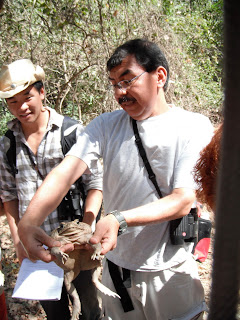
Mau holding a marine toad, which we encountered during our plant walk.
The next day we spent the morning walking around the park with our professors, learning about the plants that we saw. We have another plant test while we're at this site, so this was our first introduction to the new plant families we will be responsible for identifying later on in our stay here. 

This toad peed out (exploded would be a better word) about half of its body volume while I was holding it! Haha
In the afternoon, we had a lecture about ant/plant interactions. Acacia trees are common in Palo Verde, and you can see firsthand the acacia/ant mutualism that biology textbooks often reference when discussing symbioses.

An acacia tree with the ants that live on it. The plant provides a home (the hollow thorns) and food (nectar and protein-rich growths on the tips of leaflets) in return for the protection against herbivores that the ants provide. The ants are aggressive with biting mouthparts, and will attack anything that touches the tree they live on.
The marsh at Palo Verde, which is very close to the station where we're staying.
 After class I did some more research for my ethics presentation, which was about data manipulation and scientific misconduct in general. At 5 a few other students and I hiked up to a lookout point (mirador) behind the field station to watch the sunset, which was awesome! The sky here turns purple-ish around sunset, and from the lookout point you can see really far across the lowlands. We made it to dinner a little late because climbing down the sharp rocks took a lot longer than climbing up them did, but it was worth it. After spending some more time putting together the ethics presentation, I went to bed.

The view from the lookout point
The next morning, we drove to an agricultural region just outside of the park. While the dry forest is not normally a good place to grow crops because it's so dry in the dry season (duh), a dam was built about 30 years ago that redirects water from a river on the east side of the mountains down into the western valleys, providing water to the Guanacaste region of Costa Rica. Because the soil is relatively fertile, adding water allowed people to begin growing high-input crops like rice, sugarcane, and melons. We talked to a farmer and got to see a large rice field and a sugarcane field, although the cane had just been harvested and the field burned, so there wasn't much to see there. The rice field was pretty cool to see, though, and I especially appreciated getting the opportunity to talk to the farmer who owned the land and learning a little bit about how and why he became a rice farmer, where he gets his seeds, how he manages his land, and what happens with the rice that he harvests. Interestingly, banks will only give loans to farmers who use them to buy seeds from certain companies, so the banks essentially control the types of rice that gets planted. The types of rice that get planted furthermore determines the type of input needed to grow it. The seed companies that farmers are allowed to buy from are genetically modified to resist the herbicides that the farmers use to kill weeds, and the seeds themselves come with certain agrochemicals that the farmers then need to put into the system in order to obtain maximum yields. I'm not against genetically modified crops or non-organic agriculture in principle, but I do think it's interesting when farmers get more or less financially cornered into growing food a certain way.


A rice field flooded with water just outside of Palo Verde.
After our afternoon classes, we put the finishing touches on our ethics presentation, while people who weren't presenting had free time. We gave our presentation and led the discussion after dinner, which went relatively well. We focused on three factors that we believe can cause scientific misconduct: funding, career pressure, and advocacy. It was interesting to hear people's perspectives about how all of this relates to our potential futures, and how you can benefit personal needs (e.g. salary, career advancement, and personal beliefs and values) with scientific ethics.

We had a free day the next day, and didn't need to go to sleep as early as we normally would, so some of us decided to take a walk around the marsh at night. We saw some cool wildlife, including crocodile eyes (you can see them reflecting back at you at night, even when you can't see their bodies!), some amphibians, and a snake!

One of the frogs we saw
A snake! Not venomous, to the best of our knowledge.
After returning from the marsh, I played a round of poker with a group of classmates before going to bed around midnight. (So late! Haha.) Even though we had a rest day the next day, we have our first independent projects at Palo Verde, so I wanted to have a productive day of exploring the park and beginning to think about project ideas.

Friday, February 25, 2011

Cuerici, pt. 3: Valentine's Day, Tico Style

After we got back from the paramo, we had an evening "fireside chat" with Don Carlos about his life experiences. We got to hear some amazing insight about how he founded the Cuerici reserve, and about how he feels about conservation, both in Costa Rica and in general. Since Valentine's Day was the next day, we spent the rest of the night writing nice messages to each other on Valentine's cards that Anna, Lee, and Ellen had made for everyone in the group, including our professors and Don Carlos! It was a really sweet idea, and the next morning when we were eating breakfast we got to read our cards, which had messages from all 27 of our classmates. We had the morning free, which most people spent working on their statistics homework, and all afternoon we had an additional statistics workshop. Before dinner I went out and did my field notebook assignment (30 minutes of observations, required at every site we go to) on the back end of the oak forest trail. 

After dinner we had a discussion about the pros and cons of private vs. publicly-funded conservation, and then a group of us decided to hike back up to the mountain to look at the stars from the lookout point we'd seen during our hike with Don Carlos. About half of us decided to sleep out in an old lean-to a few minutes down the trail from the lookout, so we packed up our sleeping bags, some blankets, and snacks and headed out. 
The shack that we slept in, as seen during the day when we first found it.
It took us about an hour to hike up in the dark, with only our head lamps for light. Those of us who were sleeping out were layered up thickly since, at that elevation, it gets REALLY cold at night. I had a blanket, extra socks, water, and some random supplies in my backpack and my sleeping bag strapped to the bottom, leaving no room to pack any of my extra layers. I just decided to wear them on the way up that way I'd have them when it got cold that night. Unfortunately that was not the best decision, and everyone who was dressed to sleep out got really sweaty on the way up the steep trail, and we had to take layers off before we went to sleep because they were damp. I did the hike wearing three pairs of pants, a tank top, two t-shirts, a long-sleeve shirt, a fleece, a button-up field shirt, and a flannel.

The night hike crew getting ready to leave. I am literally wearing the maximum number of layers that I could put on my body.
We may have been sweaty when we got to the top, but we were happy! The view was amazing at night. We hung out on the lookout platform singing songs and talking for a few hours. After the people who weren't sleeping out began to hike back down, we sat in silence just watching the fog lap up against the mountains like an ocean breaking on the shore. As the clouds moved through the valley the little town would come in and out of our view, sometimes disappearing entirely under the mist so that the only light we could see was from the moon. It was incredible! After about an hour of just soaking in the mountains at night and reminding ourselves how lucky we were to be where we were, we started to get ready for bed. We walked over to the hut and arranged ourselves on the floor, avoiding the places where tree branches were coming in between the floorboards.
Up on the mountain, ready for bed! I didn't bring a winter hat to Costa Rica, so I was wearing a scarf to sleep. Haha.
We attempted to strike a balance between having a comfortable amount of personal space and sharing body heat so we'd be warm enough to fall asleep, which proved to be challenging. Around 2 or 3 am I could hear someone else still moving around, clearly awake like I was, so I sat up and saw Tessa also sitting up in her sleeping bag. We were sleeping in opposite directions and both immediately decided to rearrange so that we could sleep closer together. We did the best we could to "cuddle" while both fully zipped up in mummy-style sleeping bags, which meant I more or less slept halfway on top of her. After we moved we were both finally able to fall asleep! 

We all woke up around 5:20 the next morning because it was beginning to get light out. We walked back over to the lookout point to watch the sun rise over the mountains, which was amazing. My camera could not even come close to capturing it, by I took some photos anyway.


After admiring the sunrise for a bit, we decided to do some yoga on the lookout point. Hilary led us in some sun salutations, which served the dual purpose of being awesome and helping us stretch out after a cramped and chilly night on the mountain.

When we finished our yoga, we packed up our stuff and hiked back down the mountain to the field station, just in time for breakfast! It was really a delicious breakfast, too, after so much activity and so little sleep the night before. We got changed quickly and then left at 7:30 with the rest of the group for a day trip to El Sitio, another more remote field station that Don Carlos manages. It was our last full day in Cuerici, and instead of having regular classes or an informational hike, we had a relatively non-academic trip planned just to enjoy ourselves and our surroundings.
El Sitio station
From the road, it took just over an hour to hike to the station. We only stopped for a minute for a few people to use the bathroom, and then kept hiking. We were on a quest to see some amazing sights, including a large waterfall and a really old tree. While we didn't know in advance where we were going, the tree turned out to be our first destination. 

Arriving at the huge oak tree
There are buttresses at the bottom, even at the narrower parts above them the tree is still about 6 m in circumference. At the very base, it took 7 students' arm spans to reach around the tree. It's hard to tell tree ages in the tropics because the year-round growing season doesn't result in the formation of the rings that are so common in the temperate zone. Also, due to physiological limitations, most trees are incapable of growing much taller than a maximum height, so that also couldn't give reliable clues to the tree's age. However, because of its enormous girth and its size relative to other trees growing nearby, Don Carlos and our professors estimate that it is between 1,000 and 2,000 years old. I spent a good deal of time just thinking about how much the forest around this tree must have changed throughout its lifetime, and all of the world events that it's lived through. It's just mind-boggling!

The 1,000+ year-old oak tree, with me for scale
I'm kind of a sucker for trees, so I was pretty excited that we got to see one so incredible. After giving us a sufficient amount of time to be amazed, our professors led us to the waterfall, which was our second destination on the hike. It was a pretty cool waterfall, and was really beautiful. It looks like what you expect the tropics to look like, in a good way. In my opinion, it wasn't quite as breath-taking as the oak tree, but it was definitely worth hiking to.

Hanging out at the waterfall. Unintentionally in the foreground: Ashur.

The view from about half way up


After frolicking in the waterfall for a bit, we hiked back to El Sitio station and ate the lunches that we'd packed with us after breakfast. It started to rain and I was feeling kind of chilly (probably in large part due to the little sleep I got the night before), so I was glad when we started the hike back to the road because I could generate some body heat. When we got back to Cuerici I took an AMAZING hot shower (the water there was even better than the water at Las Cruces!) and really felt warmed up for the first time in many hours. We had one class in the afternoon, which was a science writing workshop, getting us ready for the projects we'd be doing at our next station. 

For our last night in Cuerici, we had a special dinner courtesy of Don Carlos and his trout farm. The afternoon before he let us help him catch fish from his canals, and then kill and gut them ourselves. I didn't kill or clean any of the fish, but almost everyone else did. In total I think we harvested 16 trout for our dinner Tuesday night. The kitchen staff there cooked them for us, and the trout ended up being one of the best meals I've had in Costa Rica. You could definitely taste how fresh the fish were, and how much care Don Carlos takes while raising them. After a day (and night, for many of us) full of hiking, bellies full of fresh trout made for a happy bunch of students. 

Unfortunately we had to spend the rest of the night packing, since we were leaving the next morning! By "rest of the night" I mean "from about 7:30 to 8:30 pm," since as soon as I was done I went to sleep, gloriously exhausted from the past 24 hours of adventures. When I woke up the next morning, I was definitely a little sad to leave Cuerici. The combination of the rustic but beautiful station, the amazing mountains, the unique ecosystems, and the outstandingly kind manager made it my favorite site yet. I was excited to go back to somewhere hot and more "tropical", but something inside me (maybe my inner camper/camp counselor?) was reluctant to leave the fireplaces and mountain air and sing-alongs behind. Regardless, we were on the road at 7:30 am, on our way to San Jose again!